
Rosti
In memoriam (Suomi)
Hei tänään haudattiin isäni ja olkoon hänet lepoon! Virallisesti hän kuoli syöpään ja viime metrien saakka oli lähettämässä terveisiä hyville ihmisille – Bulgariassa, Suomessa ja muualla. Ja yrittäen parantaa maailmaa, niin kuin Vihreät myös sanovat, tässä osa newfinns.com :in pimeää puolta, joka käytännössä kiihdytti isäni sairautta vakavasti.
Vaikka tähän asti Suomen Poliisi kieltäytyy virallisesta tutkinnasta asiat kanssani kehittyivät niin, että kirjoitettuani artikkelin ”To my Finland with love, ks. liite ) työnantajani johto tuli huolestunut minusta niin, että sen jälkeen kuin annoin artikkelin siloiselle Pääministerillemme Jyrki Kataiselle (2014, helmikuun alussa), minut velvoitettiin psykiatrille Suomen Terveystalon työterveyslääkärin kautta. Alempana oleva dokumentti Dnro ESAVI/1636/05.13.05.02/2014 on osa Etelä-Suomen Aluehallintaviraston (AVI) ”tutkintaa”, ja kaikki siinä esitetyt nimet liitteet ja faktat ovat todellisia. Kyseessä olivat kolme erittäin rankkaa kuukautta, joissa työnantajani edustajat tekivät valheellisia ja ristiriitaisia väitteitä, minusta ensin suuntaan ja sitten toiseen – manipuloiden lääkärien todistuksia, josta johtuen minun sukulaiset Bulgariassa tulivat hyvin huolestuneita ja isäni samoihin aikoihin todettu sairaus pahensi korvaamattomasti.
Näin ollen www.newfinns.com :in takana on erittäin pimeä ja rankka syrjintä, häirintä ja kunnian loukatusta, joista Uuden Sukupolven Suomalaisena uskallan puhua – me olemme olleet liiankin pitkään hiljaisia yhteiskuntamme huonoista puoleista ja on aika herätä ja uudistua!
P.S. Voin olettaa että tästä minulle voivat seurata lisää negatiivisia seuraamuksia, mutta en suostu hyväksymään laittomuutta, väkivaltaa tai rikollista hiljaisuutta. Alempana esitettyjen faktojen pohjalla (minulla on lisää) AVI hyväksyi työnahtajani vastaukset ja totesi että asiat ovat OK ja Suomen Poliisi kielsi kahdesti tutkimasta asian. Te voitte päättää itse mistä on kyse.
Isäni ja valoisamman tulevaisuuden kunniaksi yritän viedä asian oikeudellisesti eteenpäin - jos Suomessa se on enää mahdollista?
Ystävällisin terveisin
Rosti
Helsingissä 18.08.2015
Dnro ESAVI/1636/05.13.05.02/2014.
Hyvä Lea Kivinen, seuraavasti esitän pyytämäänne kommenttiani koskien Kauppalehden AVI:lle annettuja selityksiä, kuten osaltani asiaa vaikeuttaa vähintään se että jälleen työnantajani kirjallisesti annetuissa vastauksissa löytyy vakavia ristiriitoja. Selkeyden vuoksi seuraan Kauppalehden vastauksia kohdittain.
1) Miksi Dinkovin kuormittumiseen ei ole puututtu aikaisemmin, jos työnantaja on ollut huolissaan hänen kuormittumisestaan jo pitempään?
Johon työnantaja nyt vastaa ”Työnantaja ei ollut huolissaan Dinkovin kuormittumisesta pitempään”. Mitä sitten tarkoittavat:
- ”Viimeisen vuoden ajan työnantaja on ollut huolissaan Rostislavin työssä jaksamisesta ja mielialan vaihtelusta” sekä “Alkuvuodesta lähtien Rostislav on ollut uupunut” ks. liite 21.3.pdf
- ”Rostislav on sairauslomalla uupumuksen ja väsymyksen takia 18.3.2014 lähtien” ks. liite 4.4.pdf
Ottaen huomioon, että henkilö joka ohjasi minut ottamaan yhteyttä työterveyslääkäriin oli esimieheni Tatu Kaskela sekä että yllämainituissa työkykyneuvotteluissa osallistuivat työnantajani edustajat Tatu Kaskela ja Heini Heikkilä, jotka puhuivat puolestani enemmän kuin itse itsestäni, miten työnantajani kirjallisesti annetut väitteet tulkitaan? Sitten mainittakoon jälleen että v 2013 Susyn (ks. liitteet Susyn lähtö.pdf sekä Susyn työkuorma.pdf) ja Mikan (ks. liite Mikan lähtö.pdf) äkillisten lähtöjen jälkeen jouduin välillään tekemään jopa kahden poislähteneen kollegan työt niin että vuoden lopussa alimiehistöllä saavutettiin n 20% budjettia ylittävää tulosta. On totta että en tehnyt paljon ylityötä ajanmitattuna, koska se mitä tapahtui oli että samassa ajassa ja pienemmällä miehistöllä, tehtiin enemmän.
Asiat minun känsänvälisistä työnhauista (EU ja YK) sekä työnantajani suosituksista mm. Otto Mattsson, Tatu Kaskela ja J-P Loimuvuori pitävät paikkansa, mutta se oli yksi shokkiseikoista kuin 12.5.2014 suosittelijani Otto Mattsson ilmoitti että joku allekirjoitat sopimus työsuhteen päättymisestä tai sinut irtisanotaan vaikka laittomasti, sen jälkeen kuin 9.5 (ks. liite 9.5.pdf) työkykyneuvotelluissa oli sovittu osa-aikaisesta työhön paluustani. Käytännössä jälkimmäinen työnantajani toiminta lakkautti hakujani ja vahingoitti urani merkittävästi.
2) Keskusteltiinko Dinkovin kanssa hänen töidensä lisääntymisestä ja tavoitteista ennen työnjaon muuttumista?
Johon Kauppalehti nyt vastaa: ”Työnantaja ei tiedä, mihin töiden lisääntymiseen ja työn jaon muuttumiseen kysymyksessä viitataan”?
Mainittakoon jälleen että v 2013 Susyn (ks. liitteet Susyn lähtö.pdf sekä Susyn työkuorma.pdf) ja Mikan (ks. liite Mikan lähtö.pdf) äkillisten lähtöjen jälkeen jouduin välillään tekemään jopa kahden poislähteneen kollegan työt niin että vuoden lopussa alimiehistöllä saavutettiin n 20% budjettia ylittävää tulosta. On totta että en tehnyt paljon ylityöttä ajanmitattuna, koska se mitä tapahtui oli, että samassa ajassa ja pienemmällä miehistöllä, tehtiin enemmän ks. liitteet Tuottavuus viimeisen päälle.
3) Miksi työnantajan antamat lausunnot työkykyneuvottelujen välillä Dinkovin suoriutumisesta työssä ovat ristiriitaisia? Kuka ja millä perusteella työssä suoriutumista on arvioitu?
Johon nyt työnantaja vastaa: ”Työnantajan käsityksen mukaan työnantaja ei ole antanut ristiriitaisia tietoja Dinkovin työsuoristumisesta työssä”. Mitä sitten tarkoittavat työnantajani kirjallisesti annetut lausunnot mm. työkykyneuvottelussa 21.3.pdf (liite) minun todettiin suoriutuneen työtehtävistä hyvin. Jostain kumman syystä työkykyneuvottelussa 4.4_1.pdf (liite) kerrottiin, etten ole suoriutunut tehtävistäni, kuten jälkimmäinen on asia, josta ymmärsin jälkikäteen vasta 18.8.2014 saatuani Seppo Saloselta hänen työnantajaltani (mikä ilmeisemmin Tatu Kaskela) saatuja tietoja. Sen lisäksi tähän jälleen lisäisin että koko työterveyshuoltoprosessin aikana Kaskela käyttäytyi hyvin ristiriitaisesti ja koen, että Kaskela pikemminkin pyrki aikaansaamaan työkyvyttömyyteni kuin sitä edistämään. Tähän antaisin lisää tietoja ja todisteita mutta en enää suostu ilman jo aikoja sitten pyytämämme, minä ja lakimieheni Tero Peltonen (ks. hänen s-posti otsikolla Lisäselvitys 15.10.2014, joka laitan tähän myös liitteenä Peltonen15.10.2014.pdf), Poliisitutkintaa tai lainsäädännöllisesti järkevämpää toimenpidettä.
4) Millä perusteella Dinkovin osa-aikaista paluuta työhön ei toteutettu, vaikka niin sovittiin työkykyneuvottelussa?
Mitä käytännössä tapahtui oli että 12.5.2014 Otto Mattsson ilmoitti että joku allekirjoitat sopimus työsuhteen päättymisestä tai sinut irtisanotaan vaikka laittomasti, sen jälkeen kuin 9.5 työkykyneuvotelluissa oli sovittu osa-aikaisesta työhön paluustani (ks. liite 9.5.pdf). Sitten miten tulkittaisiin työnantajani nyt annettu lausunto että ”Työterveyslääkäri vahvisti tällöin (9.5) että Dinkov on täysin työkykyinen”. Ensiksi jos olisin ollut täysin työkykyinen miksi 9.5 työterveyslääkäri Seppo Salonen määräsi osa-aikaisesta (50 %) työhön paluusta, miksi minun sukulaiset Bulgariasta tulivat kauhoissaan hakemaan minut pois, josta olen toimittanut teille notaarivahvistettuja lausuntoja, tai miksi itse Seppo Salonen 14.5.2014 (ks. liite 18.8_1.pdf) kirjoittaisi ”jos ao halua vielä jatkotutkimuksia tai tukea jaksamiseen, niin teen lähetteen julkiselle puolelle”. Todellisuudessa niin kutsutun työkykyneuvotteluprosessin lopussa terveyskuntoni oli huonommillaan kuin koskaan sen aikana ja jos Bulgariasta tuodut notaarivahvistetut todisteet eivät riitä, Suomessa voidaan asiasta kuulustella Mirjam Louhekari, Larysa Gryadunova, Jussi Tanskanen, Dobromir Doraliiski, lääkäri Alexander Voinov, Marin Marinov, Katya Vassileva, Lazarina Valcheva.
Tässä haluan myös tuoda esiin jälleen minusta kokonaan riippumatta esiintynyt kirjallinen ristiriita Kauppalehden lakimiehen Petteri Uoti:n työsyrjintäepäilyn selityksen (ks. liite Uoti.pdf lähetetty läkinmiehelleni Tero Peltoselle 4.9.2014) ja Otto Mattssonin minulle lähetetyn s-postin välillä (ks. liite Otto Mattsson.pdf 19.9.2014).
Muun muassa Uotin selityksen mukaan ks. kolmas paragrafi 4 lause:
”……Osapuolet keskustelivat 12.5.2014 työpaikan tilanteesta ja Dinkoville tarjolla olleista töistä. Työnantaja ehdotti silloin Dinkoville yhtenä vaihtoehtona, että osapuolet sopivat työsuhteen päättämisestä ja siihen liittyvistä Dinkovin lisäeduista…..”
Sitten Mattssonin 19.9.2014 minulle lähetetyssä s-postissa (ks. Otto Mattsson.pdf) lukee:
”.....Autan sinua mielelläni antamalla myönteisen työtodistuksen, enkä pidä tarpeellisena merkitä siihen mitään työsuhteen loppuajan tapahtumista, jotka ovat johtaneet työsuhteen päättymiseen......” – siis mistä minulle, lakimiehelleni Tero Peltoselle ja mitä ihmeellisimmin Kauppalehden lakimiehelle Petteri Uotille ”työsuhteen loppuajan tapahtumista” puhutaan?
Itse pidän tehdyn sopimuksen pakotetulla oikeusasemalla tehtynä ja ollessani erittäin heikossa terveydentilassa. Asiasta pyydän Poliisitutkintaa tai mielestänne järkevämpää lainsäädinnollista toimintaa.
5) Kuka teki ratkaisun työkykyneuvottelun jälkeen Dinkovin työsuhteen päättymisestä? Millä perusteella päätös tehtiin?
Johon nyt työantajani edustaja vastaa ”Dinkov teki päätöksen itse”. Asiasta pyydän Poliisitutkintaa tai mielestänne järkevämpää laillista vaihtoehtoa.
6) Minkä vuoksi Dinkov joutui allekirjoittamaan työsuhteen lopettamisen sairauslomansa aikana?
Johon nyt työnantajani edustaja vastaa ”Dinkov ei joutunut allekirjoittamaan mitään sairauslomansa aikana”. Asiasta pyydän Poliisitutkintaa tai mielestänne järkevämpää laillista vaihtoehtoa.
7) Onko Dinkoville kerrottu hänen oletetusta aggressiivisesta käyttäytymisestään työpaikalla missään vaiheessa? Onko hänen aggressiivisesta käyttäytymisestään todisteita?
Johon nyt työnantajani vastaa ”Emme ymmärrä kysymystä. Työnantaja ei kuvannut Dinkovin käytöstä aggressiiviseksi ”. Mitä sitten tarkoittavat työnantajani valheellisesti mutta kirjallisesti työterveyslääkäreille annetut väitteet (mikä ilmeisemmin esimieheni Tatu Kaskella):
- Esimiehen mukaan tva:n käytös on ollut viimeisen vuoden aikana vaihteleva välillä iloinen väliin aggressiivinen, jolloin muut työkaverit pelkäävät tutkittavaa ks. liite 4.4_1.pdf viidennes paragrafin ensimmäinen lause, tai sitä huonommin;
- Seppo Waltimon merkinnöistä lukemat väitteet ks Waltimo 3.pdf”. Olen saanut henkilöstä ROSTISLAV Dinkov 270373-181H seuraavaa tietoa (lähteenä työterveyslääkäri ja henkilön esimies) ”Ainakin kolme henkilöä työpaikalla on kokenut Rostislavin jollakin tapaa uhkaavaksi, mm kahdenkeskeisissä tapaamisissa ollut silmän nähden hermostunut ja ”silmissä” kiilunut, pelätty että loikka pöydän ylitse. Toinen työntekijä on ilmoittanut ettei uskalla tulla aikaisin töihin koska pelkää olla Rostislavin kassa kahden.” Niiden valheellisten työnantajani antamien tietojen mukaan, joita työnantajani nyt kieltää, psykiatri Seppo Waltimo on pyytänyt minusta M1 tarkastukseen psykiatriseen sairaalaan, ilman että olisin siitä tietoinen!? Asiasta pyydän Poliisitutkintaa tai mielestänne järkevämpää laillista vaihtoehtoa.
Tähän vielä lisäisin, että johtuen helmi-toukokuun 2014 aikana minua kohti kohdistuneen työnantajani häirinnän, kunnian loukkauksen ja syrjinnän johdosta toukokuussa minut vietiin Bulgariaan todella huonossa kunnossa (ks. sieltä tuodut notaarivahvistetut todisteet), joka stressasi vanha isäni äärimmilleen. Jälkimmäinen on asia joka on kiihdyttänyt hänen sairautta, muun muassa joku aikaa sitten hänelle todettiin iso syöpä, joka on jo levinnyt niin pahasti että nyt ei voi edes leikata. Ikäväkseni ja kiistatta Kauppalehden kauttani isälleni siirtynyt stressi on kiihdyttänyt hänen sairautta ja mikä ikävimmin lääkärit ovat sitä mieltä että jos hänet olisi leikattu noin 6 kk sitten hyvin todennäköisesti olisi voitu pelastaa. Nyt tilanne on mikä on ja itse lennän Bulgariaan 10.12.2014 kertomaan isälleni syövästään, josta hän ei vielä tiedä ja lääkärit ovat sitä mieltä että itse olen paras henkilö tehdä sen. Kaikista jälkimmäisistä voin tuoda Bulgariasta uusia todisteita.
Pyydän, että asiassa selvitettäisiin minun työsuhteeni päättämisen johtaneiden syrjintäperusteiden lisäksi työnantajani edustajien toimet ja väitteet liittyen terveydentilaani. Mielestäni työnantajani kirjallisesti annetuissa lausumissa on havaittavissa vakavia ristiriitoja kautta linjan. Koen työnantajani edustajieni menettelyn häirintänä ja kunniani loukkauksena. Koen, että minua on lisäksi koetettu työterveyshuollossa saada työkyvyttömään tilaan ottamalla siellä uudelleen esille 2009 sattunut vakava auto-onnettomuus, jonka johdosta aikanaan miltei menetin henkeni.
Kunnioittaen,
Helsingissä 26. päivänä marraskuutta 2014
...right and wrong - heal the world...
Varma Kela VALITUSOSOITUS
Su(u)rullista todellisuutta ja jälleen herätys Suomi
19 vuotta sitten, 1990-luvun puolivälin jälkeen, kun olimme puolisoni kanssa Interpedian adoptiovalmennuskurssilla, meidät osallistujat pantiin pohtimaan rasismia ja sitä mahdollisuutta, että ulkomailta adoptoidut lapsemme joutuisivat rasismin kohteeksi. Muistan, miten ajattelin silloin, että sitten, kun meillä on lapsia ja varsinkin kun he kasvavat isommiksi, Suomessa ei enää ole rasismia. Ajattelin, että kun Suomeen tulee enemmän ihmisiä ulkomailta, täällä totutaan myös ulkonäöltään erilaisiin ihmisiin. Olin niin lapsellisen naiivi, että ihan vakaasti uskoin näin. Enkä sitä paitsi ollut koskaan nähnyt tai kokenut, en läheltä seurannut, millaista elämää on, kun ihminen erottuu ulkonäöltään valtaväestöstä. On helppoa ajatella, että jotain asiaa tai ilmiötä ei ole olemassa, jos jotain ei ole omakohtaisesti kokenut.
Esikoiseni oli alle 2-vuotias, kun noin ekaluokkalaiset pojat kävivät hänen kimppuunsa erään kirkon pihalla, potkivat jalkoihin, löivät mahaan, nimittelivät neekeriksi. Ei sitä voi kuvailla, miltä silloin tuntui.
Kun kerroimme tapahtuneesta, jotkut ymmärsivät, mutta monet eivät uskoneet ja pitivät meitä liioittelijoina. Jotkut myös sanoivat, että "olisit sanonut, ettei poika ole mikään neekeri, vaan intiaani". Itse ajattelin, että ei sillä ole väliä, minkä "rotuinen" ihminen on. Mutta sillä on väliä, miten muut ihmiset häntä kohtelevat ympäristössä, jossa hän on ulkonäöltään erilainen kuin useimmat muut.
Rasismi on ollut monella tavalla osa perheemme arkea viimeiset 15 vuotta. Välillä se on ollut enemmän pinnalla, välillä pitkiä aikoja on mennyt ilman mitään isompaa huolta. Ekaluokkalaisena tytär soitti minulle aina koulun jälkeen töihin, tai laittoi tekstiviestiä. Kerta kerran jälkeen toistui sama lause: "Mä oon nyt kirkon kohal". Vasta pitkän ajan kuluttua ymmärsin, mitä tytär tarkoitti. Kirkon luokse päästyään hän koki olevansa turvassa. Ostari ja sen edessä maleksivat, häijyyksiä huutelevat isot koululaiset oli ohitettu, helpotus purkautui päivästä päivään, viikosta viikkoon kirkon kohdalla, josta oli enää lyhyt matka kotiin, eikä enää ollut odotettavissa huutelijoiden ohittamisia. Välillä myös ihmettelin, miksi koulumatka kestää ja kestää. Lopulta paljastui, että tytär oli alkanut kiertää noin puolitoistakertaisen matkan välttyäkseen ohittamasta sitä ostaria ja niitä "hoojosminäolenmusta"-huutelijoita. Kerroin joskus näistä tapahtumista koulun suuntaan, koska huutelua oli myös koulussa. Sain vastaukseksi kommentin: "Hyvä, että kerrot lastesi kokemuksista". Kukaan ei kuitenkaan tehnyt mitään, jotta lasten ei tarvitsisi olla huutelun kohteena.
Esikoisen aloitettua yhdeksännen luokan ennen niin reipas koululainen alkoi voida huonosti. Ei pystynyt menemään kouluun, oli vatsaoireita, ahdistusta. Murrosikä oli raju, ja me vanhemmat olimme neuvottomia. Lopulta olimme siinä tilanteessa, että nuoren paha olo hallitsi koko perhettä. Teimme vaikean ratkaisun: isä otti vuorotteluvapaata ja muutti pojan kanssa pois kotoa, toiselle paikkakunnalle, koska näimme, että elämä kotipaikkakunnalla oli käynyt lähes mahdottomaksi. Pojan oma toive oli päästä jonnekin pois niistä ympyröistä, joissa hän velloi keskellä pahaa oloaan.
Pojan oltua useamman viikon siellä kaukana, turvassa, hän alkoi kertoa, mitä kaikkea oli tapahtunut. Hän oli joutunut sekä fyysisen että psyykkisen rasistisen väkivallan kohteeksi. Tekijöinä oli jokunen tutumpi, mutta myös täysin vieraita, yleensä aikuisia ihmisiä. Skinejä, mutta myös muita. Joku porukka tuli aina uudelleen ja uudelleen kimppuun, aseet vain kovenivat. Nuori ei alistunut, hän puolustautui. Arvet käsissä ja vartalolla kertovat vieläkin karua kieltään siitä, mitä kaikkea nuori joutui erilaisen ulkonäkönsä vuoksi kokemaan.
Tietenkään emme ole niin naiiveja, että kuvittelisimme koko murrosiän rajuuden johtuneen ainoastaan ja vain rasismista. Totta kai siihen vaikutti moni asia, kuten adoptiotausta ja itsenäistymisen tuska, samoin kuin aivoissa käynnissä ollut neurobiologinen myrsky. Mutta murrosikäiselle, jonka identiteetti on vasta muotoutumassa, rasismin kokemukset olivat äärimmäisen kuormittavia. Hän sai toistuvasti viestiä, että on vääränlainen, väärässä paikassa, eikä hänellä oikeastaan ole edes oikeutta olla olemassa.
Jälkeen päin, kun kuulimme, mitä kaikkea oli tapahtunut, ihmettelimme, miksi poika ei pyytänyt apua poliisilta. Hän oli siinä vakaassa uskossa, että jos hän olisi pyytänyt apua, hän olisi lähtenyt maijaan ja häntä ahdistelleet henkilöt naureskellen karkuun. Tämän päivän HS:n uutinen, jonka mukaan poliisi pitää rasistista väkivaltaa niin jokapäiväisenä, ettei siihen edes puututa, osoittaa, että poika oli oikeassa.
Meiltä on myös kysytty ja meitä on vanhempina syyllistetty siitä, että poika ei kertonut kokemuksistaan. Luin vastikään ruotsalaisen Mary Juuselan haastattelua, jossa hän kertoi, ettei koskaan puhunut vanhemmilleen rasistisista kokemuksistaan, koska ei halunnut huolestuttaa. Sellaisia nämä nuoret ovat, heillä on pärjäämisen pakko.
Viime sunnuntaina kirjoitin tänne faceen, että mietin, onko tyttären turvallista lähteä Helsinkiin ystävänsä kanssa junalla. Ymmärsin, että minun on hänet sinne päästettävä, nuoren pitää saada itsenäistyä pikkuhiljaa ja reissu menikin hyvin. Tämän viikon uutisointi on tehnyt selväksi, että huoli ei todellakaan ole turhaa.
Sinulle, joka luet tämän tekstin, minulla on yksi pyyntö. Kun näet, koet tai aistit jotain rasistista, tee jotain. Olipa rasismin kohde adoptoitu, pakolainen, maahanmuuttaja, suomalainen romani, ihan kuka ja minkä ikäinen tahansa. Osoita, että seisot sen rinnalla, joka on rasismin kohteena. Sano jotain tai asetu hänen vierelleen. Älä pakene, älä jätä yksin. Tee omalla käytökselläsi selväksi, ettet hyväksy minkäänlaista syrjintää. Erityisesti, jos olet työsi puolesta sellaisessa asemassa, että pystyt jotenkin vaikuttamaan asenteisiin, kuten päivähoidossa, koulussa, kaupassa, virastossa, älä katso ohi, älä katso läpi sormiesi yhtään mitään.
Lopuksi. Suuri osa meistä protestanttiseen kirkkoon kuuluvista uskomme Luojaan ja luomistyöhön. Luomiskertomus on meille tuttu, uskoimmepa tai emme. On oletettu, että ensimmäinen ihmispari asusteli jossain Intian tietämillä, mahdollisesti. Tai ehkäpä jossain päin Afrikkaa. Suomessa ei ainakaan, koska täällä ei tarkene elää pelkkiin lehviin kietoutuneena, kuten Aatami ja Eeva. Mitä luulet, kumpi oli ensin, musta vai valkoinen?
P.S. Tekstin kirjoittaja laittoi minulle viestin että on edelleen huolestunut lastensa turvallisuudesta, jonka takia julkaisen vain hänen nimikirjaimet T.M. Suurullista todellisuutta 21 vuosisadalla ja herätys Suomi!
Ystävällisin terveisin, Rosti
Nyt meillä vierailee Maarit Snellman, jolla on koskettava tarina maamme epäkohdista.
Luin ensimmäisenä aamulla postauksen puhelimella omaan adoptiolapseen kohdistuvasta rasismista. Hukkasin sen. Meillä erilaisuus on jollain lailla vaikea asia. Aina on syy vihata. Ihonväri, vamma, lahjakkuus, omaperäinen vaatetus, uskonto, seksuaalisuus, harrastukset - mikä vaan käy.
On hyvä, että olemme puhuneet nyt rasismista, mutta vieläkin tärkeämpää on ymmärtää, että se on laajempaa kuin vain etniseen taustaan perustuvaa syrjintää ja väkivaltaa. On myös näkemyksiä, jonka mukaan rasismi on ihmisten rodun, etnisen taustan tai biologisten eroavaisuuksien tai näihin liittyvien fyysisten tai henkisten ominaisuuksien erilaisuudella perustellaan ihmisten eriarvoista kohtelua eli syrjintää.
Tämä on ongelman ydin. Meillä tykätään syrjiä ja siihen ei tarpeeksi puututa. Sitä on työpaikoilla ja kouluissa ja edelleen liian usein siitä syytetään yksilöä. On KiVa - koulu ohjelma, joka on erinomainen väline kiusaamiseen puuttumiseen, mutta sitä tarttis käyttää kanssa.
Se ei myöskään toimi, jos kotoa saatu malli on syrjivä ja fobinen. Tarvitaan myös KiVa - työpaikka ohjelma. Sillä selvää on, että toimia tarvitaan.
Ei riitä, että kokoonnutaan yhteen kuuntelemaan, kun poliitikot ja julkkikset kertovat, miten syrjiminen on syvältä. Tarvitaan toki vaikuttajien selvää tuomitsevaa kantaa. Myös Hallitukselta! Mutta se todellinen työ tehdään arjessa. Puuttumalla ja kasvattamalla.
Olin peruskoulussa tukioppilas, MLL:än lasten ja nuorten puhelimen päivystäjä, monikulttuurisuuden imenyt äidinmaidosta. Minulle ei ole vaikeaa muuta kuin ymmärtää, että pitää syrjiä. Tiedän toki sen syntysyyt, mutta silti. Kyllä pitää pystyä parempaan.
Huomenna tulee 5 vuotta minun rakkaan vaikeasti kehitysvammaisen poikani Jesperin kuolemasta. Mekin kohtasimme syrjintää. Joidenkin mielestä minun äitiyteni ei ollut yhtä arvokasta kuin ns. tavisten ja lapseni nyt oli lähinnä taakka ja kuluerä. Rannalla olimme rasistisen hyökkäyksen kohteena, kun tommoset ei kuulu tänne. Mahtoiko kukaan ajatella, miltä tämä meistä tuntui ?
Kenellä on oikeus nostaa itsensä jalustalle muihin nähden ja pitää omaa olemassa olon oikeuttaan toisiin nähden arvokkaampana. Viime aikoina olen miettinyt, että ehkä on hyvä, että Jesper ei ole täällä enää. Sillä tämän kehityksen myötä, jota nyt Suomessa ollaan nähty, en olisi pystynyt takamaan hänelle KiVa elämää muualla kuin kotona. Onko oikein, että minun pitää ajatella näin?
Kasvatus alkaa kotoa. Koulu ei ole mikään taikamaa, joka korjaa kaiken. Haastan kaikki Suomen ÄIDIT mukaan kamppailuun KiVan Suomen puolesta.
Kiitos rohkeudestasi puhua vaikeista asioista Maarit ja herätys Suomi!
Ystävällisin terveisin, Rosti
Mihin mennään Suomi?
”Nykyinen käsienpesukulttuuri”, ”kollektiivinen psykoosi”, ”järjestelmällinen vastuuttomuus” jne. ovat lainattuja ilmaisuja FB keskustelusta, jossa karkeasti ottaen kysyttiin ”Mitä maassamme tapahtuu?”. Mitä vastaisit? Tässä omaa mielipidettäni – viimepäivinä mellakoiksi kulminoi pitkään kypsymässä oleva ilmiö, joka taloudellinen kriisi ja populismi vahvistivat entisestään.
Immonen, Hakkarainen, Halla-aho jne. ovat olleet kansanedustajaa useammalla kaudella ja heistä ovat äänestäneet kymmeniä tuhansia ihmisiä. Siis ”ongelma” ei ole yksittäisessä ihmisessä tai tapauksessa vain trendissä, joka on ollut pidempään esille. Ja kun otetaan huomioon faktan että Suomessa on suhteellisesti vähiten maahanmuuttajia EU maista, mutta samalla yksi isoimpia maahanmuuttovastaisia puolueita (PS), syntipukki on todella etsittävä paremmasta paikasta kuin monnikulturisuudesta. Siihen nähden sydämellisesti toivon että ”Meillä on unelma” ei jää vaan vastustusprotestina, vaan kehittyy todelliseksi uudistumis- ja sivistymisaalloksi.
Edellä oleva toive on todella syvä, koska sekaannus yhteiskunnassamme on todella iso ja jossain ulottuvuuksistaan jopa pelottava. Puhutaan sanoilla joiden merkitys vaihtelee tapauskohtaisesti ja vastuuttomuus ympärillemme kasvaa, vahingoittaen enemmän tai vähemmän kaikki. Erässä Pohjoismaiden kokouksessa entinen suomen Pääministeri oli kritisoitu että Suomessa vähemmistöt kohdellaan todella huonosti, johon hän oli vastannut: ” tästä asiasta minulla on puutteellista tietoa, mutta kuitenkin on jotain…” (kuulemani tapaus on vanha, mutta todellinen). Sellaisia vastauksia eivät enää kelpaa, koska kadun väkivalta, syrjintä ja rasismi eivät ole vitsejä vaan ikävää todellisuutta.
Itse olen ulkomaalaistaustainen Uuden Sukupolven Suomalainen, mutta tasa-arvoisena kansalaisena jopa ”hahmoni” on tulevaisuuden ilmiö, koska nykyisessä Suomessa se on syrjitty paksun ennakonluuloseinän taakse, jonka sulamisen tarvitaan apuanne. Uskaltakaa olla luovasti erilaisia ja auttaa yhteiskuntamme uudistumista vastuullisesti, oikeilla sanoilla ja teoilla.
Ystävällisin terveisin, Rosti
Finland and some dangerous trends
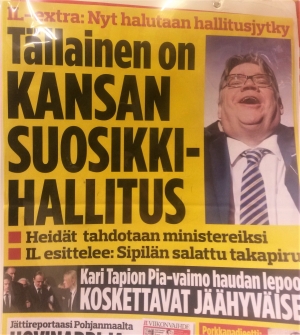
"I'm dreaming of a strong, brave nation that will defeat this nightmare called multiculturalism. This ugly bubble that our enemies live in, will soon enough burst into a million little pieces. Our lives are entwined in a very harsh times. These are the days, that will forever leave a mark on our nations future. I have strong belief in my fellow fighters. We will fight until the end for our homeland and one true Finnish nation. The victory will be ours." – Olli Immonen a Finnish Parliamentarian from the Finns Party (the former ”true” Finns). (https://www.facebook.com/olli.immonen.3?fref=ts )
That’s yet another far-right statement given yesterday by a member of the Finns Party. A statement that sparked vigorous discussions in the local social media - ranging from defending the freedom of speech to promoting far-right ideology, including comparisons to the coward deeds of Anders Breivik. Well in their best scenario those discussions, may smoothen the radically different views for the future of our small nation, but in their worse dimension they might continue the current trend of deepening radicalization. To be honest I am afraid of the latter and that’s because such polarizing statements are continuously coming from higher and higher layers of our society and reach wider and wider audience. At the same time the local authorities seem to be reluctant to react. On top of the economic difficulties all these create populist-friendly environment which overshadows our presence and future with dangerous trends from the past – such as radical nationalism, xenophobia, racism, discrimination and so.
Dear Mr. Immonen, let’s not forget that the cultural heritage of the civilized mankind, including Finland, is multicultural outcome of productive human collaboration. Just for example the Finnish alphabet was brought to Finland by Agricola from Germany, the numbers we vastly use are Arabic (1,2,3...) and Roman (I,II,III...) and the once mighty Nokia was largely international company. Furthermore the quick digitalization of our everyday life gets people and ideas closer together in an instant and in my view makes statements like yours, really difficult to understand in a creative for the nation and the contemporary trends manner. Also such statements may result in damages for the international reputation of our small nation, especially after they come from a Parliamentarian from the governing coalition.
P.S. (16.10.2020) Referring to the mentioned in the heading trends, I could mention that in the 2019 Finnish Parliamentary Elections, the Finns (the former True Finns) came again second with 17,5% of the votes, as their new chairman Mr. Jussi Halla-aho got the best ever result of 30 527 votes in the Helsinki district, which bypassed the previous 1999 record of Mr Sauli Niinistö (the current Finnish President) with 77 votes. Then Mr Olli Immonen, the chairman of Suomen Sisu (a far-right indirect branch of the Finns), was re-elected for a 3rd consecutive term, with 5856 votes, in the smaller Oulu district...
P.S.2 (3.10.2023) Now we are already into the frame of the next Finnish President elections and taking full responsibility of what I have written and quoted above I want to continue, that yet again we live in very difficult times, where on top of the downhill economic cycle and the Ukrainian war, Humanity for the first time of its written history starts facing the challenge of being outsmarted by its own invention AI - a process having the potential of even existential threat to us Humans, if MISHANDLED or simply meant to happen..*.? And since I've tried to address the matter in several of my writings and presentations ever since 2018, I want to state that I would be ready to work with anyone of the current presidential candidates, including but not only Mr Jussi-Halla-aho. Look given the Collingridge dilemma and its pacing problem we already live in uncharted territory of missing legislation and in particular areas the AI is already above human capabilities (Chess, Go, particular areas of medical diagnostics etc) as the process seems to keep axcelerating...Well according to me a natural BUT worsening human reaction to the pace of the technological change would be and already is - resisting it with old-time concepts (ex nationalism, racism, populism, xenophobia etc...), which only gives the pacing problem more space and decreases our chances to cope, flourish or may be even survive...
P.S.3 (8.10.2023) About knowledge, science and education...look at least P.S.(3,5)***
Europe after and beyond Greece ....
After a long period of volatility, austerity and unfulfilled promises and expectations – the last few weeks culminated in another empty status quo of unclear future, for both Greece and Europe. But in my view, despite the multiple crises we can see some positive developments in the make or break scenarios of the European Project. Such as bridging the gaps between its political extremes in the periphery, for instance Greece and Finland – I mean in Greece we have the left Mr. Tsipras and his government trying or rather pushed to accept the demands of the creditors and in Finland the right Mr. Soini (best known as the leader of the far-right populist Finns Party, the former “true” Finns) to keep a kind of constructive restrain on the subject, for instance by saying that “The ball now is at the hands of Greece, Kauppalehti 13.7.2015).
Well I hadn’t been able to follow the political development of Mr. Tsipras before the last Greek elections, but for Mr Soini (currently the foreign minister of Finland), such a stand sounds as a big step forward. For the readers not familiar with some prominent features and members of the Finns Party here some of its member’s quotations: http://truefinns.tumblr.com/. I might be too optimistic, but I wish to believe that the change of the tone of the leader shall reflect positively in the language and the behaviour of his followers and supporters.
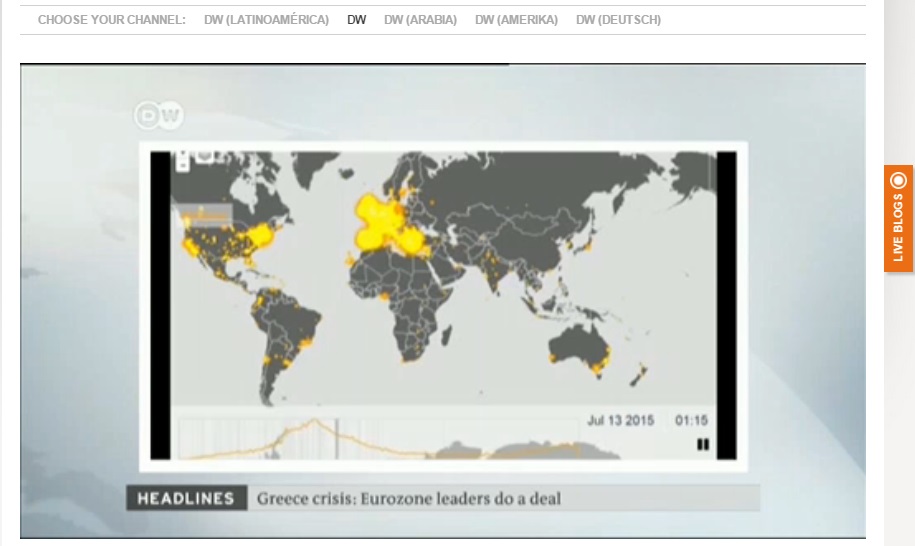
On the political arena it is likely that the third bail-out for Greece will be approved, especially after Greece’s Parliament has done it, but I want to accent on one new for Europe phenomenon – the stand of the casual people across the Union. According to news flow broadcasted by Deutche Welle (DW) see the chart bellow:
Source: Deutche Welle
After the Eurozone leaders agreed on a deal on Greece the vast majority of tweets exchanged in the net and especially in Europe, accented on the fact that Greece was pressured to accept the creditor’s terms, beyond realism and national interests. I personally am not taking a side here about who is right and who is wrong in the Greece vs Creditors struggle, but want to stress on the wider view of the general public, which in its best scenario may result in the wider foundation of European Identity – something that the struggling European Project vastly lacks at the moment. Yes in financial terms Greece is a big troublemaker but the realistic solution of the problem made more and more ordinary people express their view about Greece, Europe and our future as a Union. In that way of thoughts, today in the very center of Helsinki I saw also ordinary Finnish people (see some pictures here) expressing their solidarity with, given the circumstances, the tough terms imposed on Greece and that is how people could get united beyond borders and political frames.
If you feel or think that I am wrong, please drop me a line – what makes you feel European?
Kind regards, Rosti
The Greek debt structure a quick glance?
Well within a little bit more than a week, the Greek referendum was announced on 26 of June and held on 5 of July 2015, the small southern economy (Greek GDP amounts to less than 2% of Euro Area GDP) and its long lasted debt crisis set the whole EU project into unchartered waters – the ever more growing possibility of EU member leaving the block. Currently the biggest single creditor of Greece is the European Financial and Stability Facility (EFSF).
“The European Financial Stability Facility (EFSF) was created as a temporary crisis resolution mechanism by the euro area Member States in June 2010. The EFSF has provided financial assistance to Ireland, Portugal and Greece. The assistance was financed by the EFSF through the issuance of bonds and other debt instruments on capital markets.
A permanent rescue mechanism, the European Stability Mechanism (ESM) started its operations on 8 October 2012. The ESM is currently the sole mechanism for responding to new requests for financial assistance by euro area Member States.” (source: http://www.efsf.europa.eu/about/index.htm)
The EFSF programme started on 21 February 2012. It was originally due to end on 31 December 2014, but was extended twice upon request of the Greek government. In the context of the programme, the EFSF disbursed €141.8 billion to Greece. It included €48.2 billion to cover the costs of bank resolution and recapitalisation. Of this amount, €10.9 billion in EFSF notes was not needed and was later returned to the EFSF. Accordingly, the outstanding loan amount stands at €130.9 billion. This makes the EFSF Greece’s largest creditor by far. (source: http://www.esm.europa.eu/press/releases/efsf-programme-for-greece-expires-today.htm)
Today Greece’s debt amounts to 320 bn €, which stands for Debt to GDP ratio of 177% as the country’s unemployment rate stands at the staggering 26 % of the working population. Then the country’s leading creditors are chartered as follows:
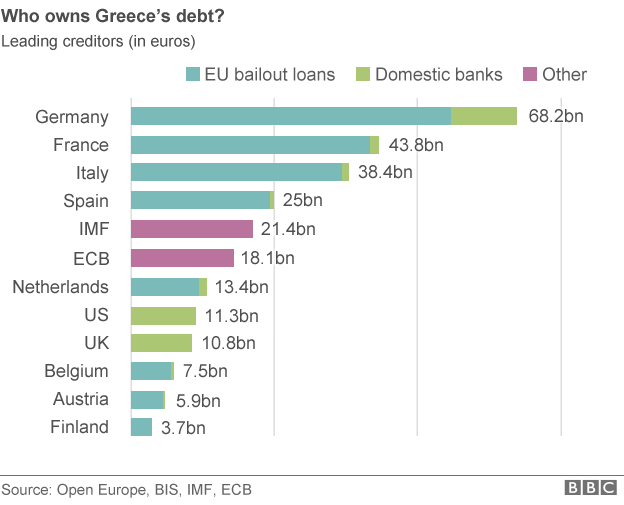
Source: http://www.bbc.com/news/world-europe-32332221
Kind regards, Rosti
HTC denies possibility for acquisition by ASUS
That’s according the press release of HTC, as of today 15.06.2015 see: http://investors.htc.com/phoenix.zhtml?c=148697&p=irol-newsArticle&ID=2059059
“We strongly deny the news. We didn’t contact Asusteck and will not consider the acquisition. As an international brand, HTC will continue to design world-class innovative smart devices through its pursuit of brilliance brand promise.”
That’s in response to last Friday statement of the Asusteck Computer Inc. (Asus) chairman Jonney Shih, that even though no formal evaluation has been made, he will not rule out a possible acquisition of the phone-maker HTC. Both companies are Taiwanese and strategically a possible merger could streamline the tough competition on the ever growing smart-phone market, as speculated on behalf of Asus. The latter is a niche where the firm has been trying to enter. Currently ( Q1 2015) the product mix of the firm (ASUS) consists of PC 67%, Mobile 16% (mobile phones and equipment), Components 14%; IOT 3%, as geographically the biggest market is Asia 52% followed by Europe 28% and Americas 20%. The firm was established in 2nd of April 1990, but has only recently entered the mobile phones business. Despite that the company is planning to ship 17 million phones this year, aiming expansion in all of the three major market-segments ( see. http://www.pcworld.com/article/2935312/asuss-shih-leaves-the-door-open-to-looking-at-htc-acquisition.html ). Further more according to the Asus business perspective (Q1 2015) the company plans its Mobile revenue to surpass that of PC’s in 2018, which sounds really ambitious. As of 31.12.2014 (1 €=38,3176 TWD) the company’s financial performance amounts for turnover of around 11,4 bn €, gross margin of around 13% and net income of around 0,5 bn €. The total balance sheet amonts for some 8,7 bn € as the cash and cash equivalent at the end of the year was about 1,9 bn €.
On the other hand HTC has been struggling with declines in both market share and profitability among the tough competition of its rivals including Apple, Samsung, Huawei, Lenovo, Xiaomi and so. On its turn the company (HTC) was founded in 1997 and ever since its product mix has been streamlined around smartphones and their accessories and support. Searching for growth lately the company is also testing new product lines. As HTC announces it since October 2014 it entered a new product category named HTC RETM – which stands for innovative camera and then at the Mobile World Congress 2015 the company introduced HTC GRIPTM- which stands for new performance fitness band and HTC ViveTM- which stands for the World’s most advanced virtual reality system, as the company announces it. And just for a quick glance the current (31.12.2014) consolidated financial performance of HTC stands for turnover of some 4,9 bn€ with gross margin of around 21,7% and net profit of some 0,04 bn € (vs loss of 0.03 bn € for 2013). The total balance sheet is around 4,3 bn €.
Kind regards, Rosti
Lyhyt puheeni Vihreiden puoluekokouksessa (Oulu 5-7.6.2015)
Hyvät kokouksen osallistujat ja johtajisto, kiitos mahdollisuudesta jakaa kanssanne pari sanaa. Viimeisen kahden päivän aikana kuuntelin paljon arvokkaita ja mielenkilintöisiä puheita. Henkilökohtaisesti olen onnellinen että puolueemme johtavissa asemissa on päässyt päteviä ihmisiä, sellaisia jotka osaavat viestittää arvojamme ymmärrettävällä tavalla ja tehokkaasti avustaa Suomen uudistamista.
Kuitenkin, uuden sukupolven suomalaisena ja eurooppalaisena tässä yritän tuoda esiin muuttamaa rakentavaa täydennystä. Usein sanotaan että ihmiset ovat oman kulttuurinsa vankeja ja hyväksyvät kritiikittömästi, toisten samassa kulttuurissa kasvaneen ihmisten sanonta ja käytöstä. Kasvaneeni kahden kulttuurin välissä olen yrittänyt poimia molempien vahvuuksia ja näin jatkaa vahvempana eteenpäin.
Maassamme puhutaan jatkuvasti tasa-arvosta ja eriarvoisuuden tasoittumisesta, mutta melkein poikkeuksetta viitaten naisten ja miesten väliseen tasa-arvoon. Samalla rasistiset ja xenophobiset tilastot ovat olleet jatkuvassa kasvussa. Siis jotain on väärässä ja uskon että on tullut aikaa puhua oikeista asioista oikeilla sanoilla – aksentilla tai aksentitta, mutta sisältöpainotteisesti.
Maassamme puhutaan paljon perussuomalaistumisen huonoista puolista ja ilmaisuista, mutta todellisuudessa tenäpäivänä he (PS) ovat Suomen toiseksi suurin puolue. Ja henkilökohtaisesti uskon että talouskriisin ja populismin lisäksi sen takana löytyy muita painavia syitä ja tässä yksi erittäin tärkeä niistä. Maamme voimassa oleva järjestys ja varsinkin lehdistö luovat perussuomalaistumiselle suotuissa ympäristöä. Miten – yksinkertaisesti uutisoimalla perussuomalaisten äärimmäiset "viisaudet" ilman käytännön seuraamuksia tai toisen puolen mielipidettä. Viime viikolla Herra Sademies räjähti lehdistön hänen mielestä rakenteellisella ehdotuksellaan, että tummia miehiä pitäisi pakkosterilisoida, tavallaan kansallisen hyvän eduksi. Jopa maamme suurin lehti HS otti yhteyttä Sademiehen, jolloin hän vahvisti sanansa vastaamalla että hän antaa konkreettinen toimenpide, ja että kysymys on siitä että tehdään ehdotuksia. (ks. http://www.hs.fi/kaupunki/a1432615500761 ).
Herra Sademies, tilastollisesti Suomella on yksi Euroopan huonompia ikärakenteita sekä prosentuaalisesti vähiten ulkomaalaisia tai ulkomaalaistaustaisia suomalaisia ja siihen nähden vaikka paikalla olevat tummat miehet rupesivat tekemään tuplasti enemmän lapsia, maamme huoltosuhde ei paranne ainakaan lähiaikoina…
Suomessa on totuttu puhumaan maahanmuuttajasta, mutta ei niiden kanssa joten jälleen kiitos että sain puheenvuoro. Ja sikäli kuin epäilen että HS ottaa yhteyttä minuun laitan kopio puheestani osoitteella newfinns.com
Ystävällisin terveisin
Rosti
Single transferable vote (STV) – an example
Hello last week I was involved in a conference, where I had to vote via procedure called single transferable vote, for the first time in my life. Well the procedure is over a 100 years old and now days is broadly used in Australia, New Zeeland, Ireland and Malta, but being new for me I decided to learn something more about how it works. In Finland there is almost no literature about, so I developed the example bellow on the basis of what I’ve learned from the net. Verbally that’s an iterative voting process for multiple choices, where the excessive and the lacklustre votes are redistributed according to the ordered preferences of the voters. The qualifying quota is defined on the basis of the voters and the seats.
Let’s assume we have 4 applicants for 2 seats and 24 voters. Then the threshold (quota) , calculated by the formulae proposed by Newland and Britton in 1973 (there are also other options), would be V/(s+1)=24/(2+1) =8 votes, where “V” is the number of voters and “s” the number of seats. In a real vote you are not requested to arrange all candidates, but let’s see in how many ways we could arrange the 4 candidates assuming all possible ways, that’s 4!=4*3*2*1=24 or the number of permutations (arranged order) of the four options. Well for those of you who will perceive it better visually hear I made a table:
| ballot |
I |
II |
II |
IV |
|
1 |
a |
b |
c |
d |
|
2 |
a |
b |
d |
c |
|
3 |
a |
c |
b |
d |
|
4 |
a |
c |
d |
b |
|
5 |
a |
d |
b |
c |
|
6 |
a |
d |
c |
b |
|
7 |
b |
a |
c |
d |
|
8 |
b |
a |
d |
c |
|
9 |
b |
c |
a |
d |
|
10 |
b |
c |
d |
a |
|
11 |
b |
d |
a |
c |
|
12 |
b |
d |
c |
a |
|
13 |
c |
a |
b |
d |
|
14 |
c |
a |
d |
b |
|
15 |
c |
b |
a |
d |
|
16 |
c |
b |
d |
a |
|
17 |
c |
d |
a |
b |
|
18 |
c |
d |
b |
a |
|
19 |
d |
c |
a |
b |
|
20 |
d |
c |
b |
a |
|
21 |
d |
a |
c |
b |
|
22 |
d |
a |
b |
c |
|
23 |
d |
b |
c |
a |
|
24 |
d |
b |
a |
c |
As I said that’s the full number of possible options, which in real elections will or may not be reached (some of the 24 options may not be chosen, some of the voters could put less than 4 options in the ballot paper, some of the ballots could be invalid or so). Well let’s assume that our 24 voters made the following 4 preferences:
|
Raw/ballot |
I |
II |
II |
IV |
Voters |
|
4 |
a |
c |
d |
b |
5 |
|
10 |
b |
c |
d |
a |
3 |
|
12 |
b |
d |
c |
a |
4 |
|
16 |
c |
b |
d |
a |
3 |
|
17 |
c |
d |
a |
b |
3 |
|
22 |
d |
a |
b |
c |
6 |
|
|
|
|
|
Sum |
24 |
Then if we arrange the choices according to their first preference we get:
|
Candidates |
Voters |
|
|
b |
7 |
3 and 4 |
|
c |
6 |
3 and 3 |
|
d |
6 |
|
|
a |
5 |
Or our favourite is “b” with 7 first choices, but none of the candidates has passed the threshold of 8. Well in such case we drop the candidate with least votes off, in our case that’s “a”, and redistribute the votes among the other candidates. We also drop the 5 voters, who put “a” as their first choice, hence we have to recalculate the quota: 19/(3+1)=4,75. That way “b” automatically qualifies with 2,25 excessive votes (7-4,75), but let’s see who comes next since “c” and “d” have 6 votes each.” The rule for weighting the count of the transferable votes is: transferable votes minus quota equals surplus, and the surplus is divided by the transferable votes. (This is Gregory's method or the Senatorial Rules, named after the use of STV in various Commonwealth senates)” (http://www.voting.ukscientists.com/stvcount.html ). So since the votes of both “c” and “d” is 6 it’s obvious that whatever equal number or fraction we add to the base, the equality will remain, but I will do it just to show the principle of redistribution. So with the recalculated quota (4,75) our transferable votes (5) give a surplus of 1/4 and transferable weight would be (¼)/5, which is 1/20 or 0,05. Therefore the new values for “c” and “d” will be 6,05 both (that’s if 1 vote is assumed redistributed) and we have to eliminate again one of them, but which one. Well in such case we could simply chose them randomly by a lot or if accepted as a general rule we could follow the order of the initially eliminated permutation a>c>d>b, where the 5 voters ranked “c” second and “d” third or arithmetically following that we could redistribute to “c” 3 votes (6+(3/20)) =6,15 and to “d” 2 votes (6+(2/20))=6,1 hence final winners are “b” and “c”. There are several different methods for redistributing the votes and you could read about them here:
http://en.wikipedia.org/wiki/Counting_single_transferable_votes and here a few more good links:
http://www.hawaii.edu/uhmfs/documents/2010_11/20110216_reso_votingmethodscounting.pdf
Kind regards
Rosti
Pro European initiatives – Horizon 2020
After the Finnish elections (19.4.2015) I started searching for pro European programmes and some time ago I rediscovered the Horizon 2020. Well I had some vague memories about it from the time it was initially launched (the end of 2013), but since then I haven’t seen any major public discussions about it, at least here in Finland. As officially announced, it is the EU frame programme for research and innovation (https://ec.europa.eu/programmes/horizon2020/en/ ) with some 80 € bn budget for the period 2014-2020. Well the lump sum of the project may seem much, but if we take it on yearly basis it comes at 11,4 € bn for the whole Union, which has population of some 507,4 million people (2014). Just for comparison the Finnish state budget for 2014 was some 54 € bn or the Austrian some 76 € bn as the given countries populations were respectively about 5,5 and 8,5 million people. Even though a state budget has many functions and cannot be directly compared to the budget of Horizon 2020, I chose two small EU member states just for general comparison of the whole EU aspiration and a state level. I believe that that’s important especially now, when it seems like the trust in the whole EU project is greatly at stake with Greece at the edge of collapse and UK planning a referendum (could be held as early as 2016 ) about its EU membership. Not to mention the EU-Russia tensions, which according to me are quite worrisome and regrettable?
Anyway, the Horizon 2020 itself consists of 3 pillars which are Excellent Science, Industrial Leadership and Societal Challenges, broken into subprojects (calls) and budgetary frames. You could see more information directly from the online guide of the Commission, including a step by step procedure for registration or you could use the service of some consulting agency.
Also in the EU member states as well as some none EU countries there are established National Contact Points, which could give you detailed information about the whole project. You could check the point for your country here. The opened calls for this year are listed here, as the submission deadline for many of them is 28.5.2015, but you may have enough time for the later once. The subject I was looking for is more or less summarized in the call Reflective 2 2015, which brief heading is – “Emergence and transmission of European cultural heritage and Europeanisation”. As you can see from the given link it is expected that the “research will support the EU cultural policies linked to fostering the emergence, transmission and use of cultural heritage at local regional, national and, in particular, European level”. In my best belief it is the latter that’s missing at most regarding both the EU inner problems and the rapidly changing global realities.
Well if the so called calls (programmes) are primly for institutional researchers one can be enrolled in the project on a personal expert level. For more information check here (see also the information given in the online guide).
While searching for pro European initiatives I occasionally found an interesting Europe debating page (http://www.debatingeurope.eu/debates/), where one could participate or just read without being researcher or expert.
Kind regards, Rosti
Conditional probabilities of parity – Finnish lotto and Eurojackpot (reposted)
Hello guys! I am pleased with your comments about my site and articles just have no physical recourse to answer to all of you, so in brief. Yes the idea of newfinns.com is mine and all the articles on it are written by me Rosti, but I am only a small person striving for better place under the Sun☺, for as many of us, as possible☺. So yes you are welcomed and allowed to share and quote my articles. That way the power of our shared thoughts grows and slowly but surely moves ahead, closing the gap between some of the realities around us and our better tomorrow.
Those of you, who have watched through the site have probably noticed that the idea of a New Finnish and European generation was also my candidacy for the Finnish Parliamentary Elections, but instead of New Finns a vast majority of the local voters chose “True” Finns .....
Well someone has said that “life is what happens with us, while we are making plans about it”.... So through my articles I try to continue my renewal aspiration and since the mobile version of the site focuses on my comments, here I will repost the “conditional probabilities of parity” of the Finnish lotto and the Eurojackpot, as the given algorithm can be developed for any limited distribution of type “N” out of which are chosen “n” numbers without repetition.
In Finnish lotto for the prime reward you select 7 main numbers out of 39. Did you know that if we speak about the top prize, the probability that within the selected 7 prime numbers there will be at least 2 consecutive numbers is as high as 72.23%☺? Or for example, that the probability that within the 7 selected numbers will be, let’s say, exactly one pair is equal precisely to 43.21%☺. Well here I have developed for you a complete table-calculation, in which I have presented all possible probability results, regarding the sample distribution of the 7 selected numbers:
| N | Distribution | g (=n. elem.) | r (=n. elem. perm.) | Combin. | ((N-n)+1)! | g! | (33-g)! | Probab.% |
| 1 | 1+1+1+1+1+1+1 | 7 | 1 | 4272048 | 8.683E+36 | 5040 | 4.03E+26 | 27.77 |
| 2 | 2+1+1+1+1+1 | 6 | 6 | 6645408 | 8.683E+36 | 720 | 1.09E+28 | 43.21 |
| 3 | 2+2+1+1+1 | 5 | 10 | 2373360 | 8.683E+36 | 120 | 3.05E+29 | 15.43 |
| 4 | 3+1+1+1+1 | 5 | 5 | 1186680 | 8.683E+36 | 120 | 3.05E+29 | 7.72 |
| 5 | 2+2+2+1 | 4 | 4 | 163680 | 8.683E+36 | 24 | 8.84E+30 | 1.06 |
| 6 | 3+2+1+1 | 4 | 12 | 491040 | 8.683E+36 | 24 | 8.84E+30 | 3.19 |
| 7 | 4+1+1+1 | 4 | 4 | 163680 | 8.683E+36 | 24 | 8.84E+30 | 1.06 |
| 8 | 3+2+2 | 3 | 3 | 16368 | 8.683E+36 | 6 | 2.65E+32 | 0.11 |
| 9 | 3+3+1 | 3 | 3 | 16368 | 8.683E+36 | 6 | 2.65E+32 | 0.11 |
| 10 | 5+1+1 | 3 | 3 | 16368 | 8.683E+36 | 6 | 2.65E+32 | 0.11 |
| 11 | 4+2+1 | 3 | 6 | 32736 | 8.683E+36 | 6 | 2.65E+32 | 0.21 |
| 12 | 5+2 | 2 | 2 | 1056 | 8.683E+36 | 2 | 8.22E+33 | 0.01 |
| 13 | 6+1 | 2 | 2 | 1056 | 8.683E+36 | 2 | 8.22E+33 | 0.01 |
| 14 | 3+4 | 2 | 2 | 1056 | 8.683E+36 | 2 | 8.22E+33 | 0.01 |
| 15 | 7 | 1 | 1 | 33 | 8.683E+36 | 1 | 2.63E+35 | 0.00 |
| Sum | 15380937 | Sum | 100.00 |
Thus for example, the distribution of type 5+2 is one which has five consecutive numbers (ex. 23,24,25,26,27) and one pair (ex. 36,37) and out of the all 15 380 937 possible combinations there are exactly 1 056 pieces (0,01%) 5+2 ones☺. Then if you want to see the number of the possible combinations in which there is NO consecutive numbers, the type 1+1+1+1+1+1+1, (ex. 2,7,9,14,19,23,33), there are exactly 4 272 048 such combinations (27,77%) ☺! Or...there are exactly 33 combinations (0,0002%) where there are 7 subsequent numbers ☺, the first is 1,2,3,4,5,6,7 and the last is 33,34,35,36,37,38,39, the rest 31 are between them...this way you could check if my calculations work, but If you are interested in a more gentle way of how I calculated the probabilities send me a message. The solution is not directly in the textbooks ☺!
Eurojackpot
I got a feedback from a member of the New Finnish and European generation that he wants to see the conditional probabilities of sequence of the Eurojackpot regarding the top prize and here I give you the solution:
|
N |
Distribution |
g (=n. elem.) |
r (=n. elem. perm.) |
Combin. |
((N-n)+1)! |
g! |
(46-g)! |
Probab% |
|
1 |
1+1+1+1+1 |
5 |
1 |
1370754 |
5.5E+57 |
120 |
3.34525E+49 |
64.70 |
|
2 |
2+1+1+1 |
4 |
4 |
652740 |
5.5E+57 |
24 |
1.40501E+51 |
30.81 |
|
3 |
2+2+1 |
3 |
3 |
45540 |
5.5E+57 |
6 |
6.04153E+52 |
2.15 |
|
4 |
3+1+1 |
3 |
3 |
45540 |
5.5E+57 |
6 |
6.04153E+52 |
2.15 |
|
5 |
3+2 |
2 |
2 |
2070 |
5.5E+57 |
2 |
2.65827E+54 |
0.10 |
|
6 |
4+1 |
2 |
2 |
2070 |
5.5E+57 |
2 |
2.65827E+54 |
0.10 |
|
7 |
5 |
1 |
1 |
46 |
5.5E+57 |
1 |
1.19622E+56 |
0.00 |
|
Sum |
2118760 |
Sum |
100.00 |
For the main prize in Eurojackpot first we select 5 main numbers out of 50 and then 2 additional numbers out of 10. Thus, the 5 main numbers can be selected in 2 118 760 different ways and the two additional numbers in 45 ways. Then for the jackpot (5 and 2) the number of all possible combinations is 95 344 200 (= 2 118 760 * 45). Hence speaking about the probability of the top prize we have 1/95 344 200 = 0.00001 per thousand (if you play with one combination☺). On the other hand, for example, the probability that the selected 5 prime numbers could contain a pair (ex. 7,8 (or another one out of the 49☺), distribution of type 2+1+1+1) is equal to 30.81% and etc. for the other alternatives.
Probably you have also noticed that compared to the Finnish lotto here the probability that within the 5 prime numbers there will be NO consecutive ones is as high as 64,70% (vs 27,77%), which said in simple language is due to the fact that we select fewer numbers (5) out of a larger initial set (50).
Since in the coming week the top prize in Eurojackpot is close to 90 000 000 € one could ask how the above calculations could help, to which I would answer – by giving you a better understanding of what could happen, especially in a long run. In general in a long run you are supposed to be a more successful player if you play Eurojackpot with unpaired numbers (ex. 2,8,11,25,43) for the main draw. For the additional 10 numbers draw you have (n-1)=9 possible pairs ex. 1:2,2:3...9:10 (here that’s the only parity possibility), hence a probability of (9/45)*100=20% to occur.
P.S. Because some of my comments were spammed I asked my administrator to activate a registration system, which shall be on place in the next few days. I hope that that way I will be able to better follow and hopefully answer your comments.
P.S.2 Since recently I’ve updated the probability calculations for the Finnish Lotto, which rules are changing (for those who want to see it it’s here (In Finnish:))), I’ve decided to add to this article the general probability distribution table for the Eurojackpot as well. The results of the latter are of course the same as these in Wikipedia and other sites , but I also want to show how they can be calculated.
|
|
A |
B |
C |
D |
E |
F |
G |
H |
I |
|
N |
Winclass |
Com(n;r) |
Com (N-n;n-r) |
Com(a;o) |
Com (A-a;a-o) |
Com(N;n)*Com(A;a) |
Probab. |
1/Probab |
Com spread |
|
1 |
5+2 |
1 |
1 |
1 |
1 |
95344200 |
1,04883E-08 |
95 344 200,0 |
1 |
|
2 |
5+1 |
1 |
1 |
2 |
8 |
95344200 |
1,67813E-07 |
5 959 012,5 |
16 |
|
3 |
5 |
1 |
1 |
1 |
28 |
95344200 |
2,93673E-07 |
3 405 150,0 |
28 |
|
4 |
4+2 |
5 |
45 |
1 |
1 |
95344200 |
2,35987E-06 |
423 752,0 |
225 |
|
5 |
4+1 |
5 |
45 |
2 |
8 |
95344200 |
3,77579E-05 |
26 484,5 |
3 600 |
|
6 |
4 |
5 |
45 |
1 |
28 |
95344200 |
6,60764E-05 |
15 134,0 |
6 300 |
|
7 |
3+2 |
10 |
990 |
1 |
1 |
95344200 |
0,000103834 |
9 630,7 |
9 900 |
|
8 |
2+2 |
10 |
14190 |
1 |
1 |
95344200 |
0,001488292 |
671,9 |
141 900 |
|
9 |
3+1 |
10 |
990 |
2 |
8 |
95344200 |
0,001661349 |
601,9 |
158 400 |
|
10 |
3 |
10 |
990 |
1 |
28 |
95344200 |
0,002907361 |
344,0 |
277 200 |
|
11 |
1+2 |
5 |
148995 |
1 |
1 |
95344200 |
0,007813532 |
128,0 |
744 975 |
|
12 |
2+1 |
10 |
14190 |
2 |
8 |
95344200 |
0,02381267 |
42,0 |
2 270 400 |
|
13 |
2 |
10 |
14190 |
1 |
28 |
95344200 |
0,041672173 |
24,0 |
3 973 200 |
|
14 |
1+1 |
5 |
148995 |
2 |
8 |
95344200 |
0,125016519 |
8,0 |
11 919 600 |
|
15 |
1 |
5 |
148995 |
1 |
28 |
95344200 |
0,218778908 |
4,6 |
20 859 300 |
|
16 |
0+2 |
1 |
1221759 |
1 |
1 |
95344200 |
0,012814193 |
78,0 |
1 221 759 |
|
17 |
0+1 |
1 |
1221759 |
2 |
8 |
95344200 |
0,205027091 |
4,9 |
19 548 144 |
|
18 |
0 |
1 |
1221759 |
1 |
28 |
95344200 |
0,35879741 |
2,8 |
34 209 252 |
|
1 |
95 344 200 |
So given the current rules where we chose 7 numbers in 2 separate draws, 5 out of 50 and 2 out of 10, we could present a table with all possible winning (column A, rows 1:12) and not winning classes (column A; rows 13:18) like the one above.
In addition I presented the classes of all possible combinations and their corresponding probability as decimal number (column G) and 1/probability ratio (column H). The latter might be an easier way to grasp your winning chance. For instance your chance to get 5+1 correct is 0,0000001678(raw 2, column G) which is small, but 1 out of 5 959 012,5 (which is the same) could give you a better comparison of how small. Reciprocally you could calculate the probability per 1, by dividing all possible combinations 95 344 200 (column F) by the “combination spread” per class (column I), as I call it. So again for 5+1 we will have 95 344 200/16=5 959 012,5. Said in other words, out of the all 95 344 200 possible combinations we have exactly 16 of the class 5+1, exactly 9 900 of the class 3+2 and so on, and the corresponding chance to win can be calculated by dividing all possible combinations by those possible per class, which gives you winning chance per 1.
For those of you who might want to make the calculations themselves I have presented the pieces of the equation in the heading of the above Excell or any other spreadsheet programme that has combinations, but let’s put them together (Com=combination):
(Com(n,r)*Com(N-n;n-r))*(Com(a;o)*Com(A-a;a-o))/((Combination(N;n)*Combination(A;a))=Probability(in decimals) where “n” is the chosen numbers of the prime draw (5;) “r” is the number of the correct numbers in your coupon (anything from 5 to 0); “N” is the numbers of the first prime draw (50); “a” is the chosen numbers of the second draw (2); “o” is the correctly guessed numbers out of it (2,1 or 0) and “A” is the numbers in the additional 10 numbers draw huh... So substituted with numbers for let’s say 5+1 it would be:
(Com(5;5)*Com(45;0))*(Com(2;1)*Com(8;1))/(Com(50;5)*Com(10;2))=0,0000001678. Or for exactly 3 (3 from the prime draw and 0 from the additional draw) correctly guessed numbers and using any Calculator which has combinations, normally marked by nCr, we have: (5C3*45C2)*(2C0*8C2)/(50C5*10C2)=0,002907. If you want to read more for instance here and here are given well explained similar examples of the mathematical principles applied.
So once again good luck, knowledge or both! (Helsinki 4 Oct 2016)
Kind regards, Rostislav Georgiev Dinkov
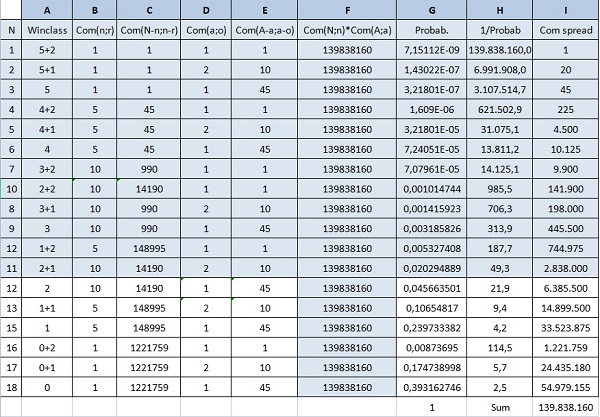
P.S.3 (13.3.2022) Read from an Eurojackpot cupon - starting 19.3.2022 there will be a second draw per week as the number of the second probability draw grows to 12 (from 10) which makes 66 additional combinations and the number of all combinations grows to 2 118 760*66 = 139 838 160
P.S.4 (15.11.2022) Here just the new general probability table of Eurojackpot (and Euromillions), which takes into account the two additional numbers in the second draw (look P.S.3)
P.S.5 (19.6.2024) Probabilistic patterns of Odd and Even numbers along the main 5 of 50 draw of combinations in both Eurojackpot and Euromillions…:
|
Odd |
Even |
Combinations |
Probability % |
|
5 |
0 |
53130 |
2.51 |
|
4 |
1 |
316250 |
14.93 |
|
3 |
2 |
690000 |
32.57 |
|
2 |
3 |
690000 |
32.57 |
|
1 |
4 |
316250 |
14.93 |
|
0 |
5 |
53130 |
2.51 |
|
2118760 |
100.00 |
"True" alongside New Finns
Because people are prisoners of their own culture, their behaviour seems right to other people that have been raised in that culture (and have adopted it).(Derek Rollinson Organisational Behavuior and Analysis …2005 p. 123)
It is proved that there are strong correlation and interdependence between society and organizational culture and behaviour. That correlation is even stronger in collective societies such as the Finnish one, so here I’ll try to give some prime features describing the latter.
Finland is young (in 2017 it will celebrate its 100 years independence) and in a way geographically isolated state, for which the free movement of people is relatively new and unknown thing. Quite naturally the first reactions towards those movements are resistance and fear and probably that’s one of the prime reasons for the strong performance of the populist-nationalistic Finns Party (the former True Finns), who came second in the 2015 Parliamentary elections.
Because of the historical and geopolitical reasons (about 600 years Swedish ruling, some 200 years Russian autonomy and only a hundred years of independence) it seems that the local society has been built around very strong collectivist principles, resulting in really strong social identity. According to the social identity theory, people perceive themselves in some proportion of their individual and their social identity features.
Individual identity consists of personal characteristics and abilities, such as personal look, character and personal capabilities.
In contrast social identity emphasizes on belongings to different groups and organizations. In collective societies the weight of one’s self-perception falls upon the social identity characteristics.
Hence people have variable perception of their identity given their culture and the surrounding conditions. Of course as a social being one belongs to different groups. In that way of thoughts and for example a Police clerk who mentally perceives himself as a Finn, a family member, organizational member, European and so on, would see himself and behave differently than a Police clerk who mentally orders his personality descriptions in different way, ex. European, professional, family member a Finn or some other prime for the being or the group qualities. Quite likely the “True Finns” and their voters feel challenged by some or many of the new EU values and characteristics and try to resist them.
Naturally we like a positive self-image hence we try to choose a group that at best promotes it (Steven McShane Organizational Bahavior 2003 p. 68) and in the collective Finnish society that group tends to be “we the Finns” (for the non Finnish reader I want to mention that in the spoken Finnish is quite common that the individual speaks in 3rd person “we” about himself or actions). Collectivism means the subjugation of the individual to a group—whether to a race, class or state does not matter. Collectivism holds that man must be chained to collective action and collective thought for the sake of what is called “the common good.” (http://aynrandlexicon.com/lexicon/collectivism.html )
Again given some historical and geopolitical reasons the local society has developed a strong belief for collective Finnish success achieved through hard work, after getting independent. That way, following the inertia of the past it is believed that the already established way of collective social success is the best way to proceed forward.
Well I have never objected being a productive team-player, but somehow people like me, who proclaim themselves as members of a New Finnish and European generation, face the strong resistance of the established bigger group. We the New Finns are left automatically out of the “we the “true” Finns” collective identity perception and we the New Finns struggle to survive as a minority in many even given by the law regards.
The social-identity perception is a dynamic process, where “we” describe ourselves by prominent for our group and culture features, such that make us differ from people belonging to other groups. But in order to defend our positive self-image “we” often create a positive picture for our group and a more negative one about the people belonging to other groups (Steven McShane Organizational Bahavior 2003 p. 68-69). This process is called stereotyping, which in this case is a wider dimension of the social identity – a process where we believe that people possess certain features, due to their belonging to certain social group (C. Mcrea ”Social Cognition:Thinking Categorically about others” Annual review of psychology 51(2000)p93). In my study I have cited a research done among Finnish employers (2005), where they state – that the foreigners do not bring new clients or help the business development. Something like if the person “X” is a foreigner, hence does not belong to “we the Finns”, he is automatically a low quality worker, which by itself is uncritically accepted prejudice. The stereotypes are never as precise as the individual knowledge about the person. Often the stereotypes are based on prejudices, which are unfounded negative emotions towards people belonging to certain groups (Steven McShane Organizational Bahavior 2003 p. 70-71).
Fortunately our emotions are man-made☺ - they are a part of our personality and develop according to the conditions around us (Rosenberg, 1960). And today we live one of the biggest changes in our civilization, the Globalization – a process where the environment around us is changing rapidly and our emotions shall follow suite, for good I hope.
This is part of a paper (in Finnish) I wrote some 9 years ago. During that time many things regarding me, Finland and Europe have changed, some for good other not. But I hope that during that process of change we both the “True” and the New Finns have learned more about each other for the sake of the common civilized good if you wish.
PS (24.5.2026) Al-Khwarizmi - The Forgotten Genius Behind Every Algorithm
Kind regards, Rosti...
Nokia, Alcatel Lucent, Huawei and Ericsson – a general glance
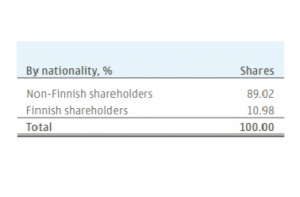
P.S. (23.10.2020) the small front picture represents the percentages of Non-Finnish (89,02%) and Finnish based (10,98%, source) shareholders (on 31.12.2008), when Nokia was still the Global mobile devices market leader ... "... does not matter how fast you run, if it's in the wrong direction *** ". The articles of newfinns.com contain a lot of hyperlinked vertical content, ex songs, videos, pictures, documents and so, related directly to the core of the subject...
On 14 of April (2015) the Finnish based Nokia responded to some long lasted media speculations with official statement, that the company (Nokia) is in advanced negotiations for full merger with the French based Alcatel-Lucent. Following their development the preceding major reorganizations in the companies’ history were the merger of Alcatel with Lucent Technologies (2006) and the joint venture between Nokia and Siemens AG (2007), known as Nokia Siemens Networks. Subsequently Nokia bought the Siemens AG stake of the joint venture (July 2013) and sold its mobile phone business to Microsoft (September 2013).
Anyway, since the current 15,6 billion € takeover is the biggest in the Finnish history and once Nokia Corporation was the mightiest Finnish company counting for about 4% of the country’s GDP, let me try to give you a small comparison of what the mighty Nokia was compared to today and what it is intended to be through the current merger and its prime rivals, the Swedish Ericsson and the Chinese Huawei.
For that let me take the year before the financial and the consequent economic crisis 2008, which looking backwards seems to be the starting point of the downhill for the company. Then the Finnish giant and the global mobile market leader (market share of over 40%) made turnover of 50,7 billion €, had a balance sheet of 39,6 billion € and personal of 125 829 people. Today, as of 31.12.2014, the restructured Nokia has a turnover of 12,7 billion €, balance sheet of 21,1 billion € and personal of 61 656 people. So let’s see how the latter stands against its current prime rivals.
|
31.12.2014 |
Turnover €bn |
Balance €bn |
Staff |
Gross margin % |
Net income/loss €m |
Equity ratio % |
|
Huawei |
38.24 |
41.11 |
150000* |
44.2 |
3696 |
32.3** |
|
Ericsson |
24.28 |
31.26 |
118055 |
36.2 |
1232 |
49.5 |
|
Alcatel Lucent |
13.20 |
21.50 |
52673 |
33.4 |
-118 |
12.6** |
|
Nokia |
12.70 |
21.10 |
61656 |
44,3 |
1163 |
49.1 |
Source – the annual accounts of the above companies at 31.12.2014 or their pro forma.
* for 2013
** Calculated on the basis of the balance sheet, the calculated by the firm ratio may differ
*** CNY/EUR exchange rate 0.1327 and SEK/EUR rate 0.1065 (31.12.2014)
Even though Huawei has not yet reached the mighty years of Nokia, as seen from the table by net sales it tops the ranking, as of course one should not forget that the Chinese firm has a wider product portfolio than the listed competitors. Although the situation remains unchanged if we take only the carrier business (the direct competitor of the other firms), which for 2014 amounts to 66,7% of the net sales (25,5 bn€). Hence the combined sales volume of the new Nokia-Alcatel Lucent merger comes really close to the edge of its rivals.
Then it might be interesting to note that compared by gross margin profitability Nokia (44,3%) and Huawei (44,2%) achieve almost equal results as Alcatel Lucent comes as underperformer (33,4%) and the only net loss (-118 m€) generating firm. The latter is a matter where many industry analysts point their hesitations, whether Nokia will be able to successfully merge the French-American enterprise into profitable venture, while keeping ahead with the competition and the technological developments!? Following that way of thoughts I intentionally took or calculated a measurement of solvency, such as the equity ratio where clearly Alcatel Lucent is the under performer or the most indebted firm, due pretty much to the accumulated during the years losses.
I personally wish success to the new enterprise and since for years Nokia was the pride of the Finnish economy, let me try to bring in light some dimension resembling a measurement of local significance. According to YLE (http://yle.fi/uutiset/nokias_alcatel-lucent_merger_largest_corporate_acquisition_in_finnish_history/7931413) the sales volume of the new merger, sales of about 26 bn €, will equal about a half of the Finnish state budget. So may both of the them grow healthily☺.
P.S.2 (29.12.2023) Paljonko Suomalaisuudesta on suomettumista?
Finland, vigorous election campaigns among some anti NATO and EU protests
If you do not know 19 of April 2015 is the date of the Finnish Parliamentary elections and according to the current rules the period 8-14.4.2015 was the time of the preliminary elections inside Finland. According to an article of Helsinki Times (http://www.hs.fi/politiikka/a1428983371550), this time the percentage of the voters who gave their vote beforehand was slightly higher 31,9% vs. the last Parliamentary elections in 2011, 31,2%.
Well during the last 17 years I have never seen so lively election campaigns and compared to previous years this time many of the candidates are young people. According to me both, the rise of the youth and the untypical for the Finnish nature vast campaign activity are pretty much due to the failure of the old-fashioned governing practises applied in the country so far. More and more local people start comprehending that keeping Finland in the shadows of the True Finns mentality (typical for other local parties as well), keeps Finland aside from the global trends and realities, which is really harmful for our small export-oriented economy. The signs for that are evident from everywhere – the downgrade of the Finnish credit rating by S&P and the warning by Fitch or the emigration of Björn Wahlroos, Karl Fazer (prominent local entrepreneurs) and many ordinary well educated young people and so. The latter must have been strong enough wake-up calls for the small nation, but still because of its bad age-structure, the majority of the voters are elderly people, it’s to be seen what will happen? One of the likely scenarios is another government of broad coalition, which I am afraid will be pretty much unable to implement the radical reforms needed. Some, including the likely coming prime minister Juha Sipilä, say that Finland could become the next Greece (http://www.thetoc.gr/eng/politics/article/austerity-overshadows-election-in-finland) others like the current Prime minister Alexander Stubb say that Finland could face another lost decade (see the same article)!?
But let me tell you also about an event, which remained completely unreported by the media here or elsewhere, including the social media (in Finland, strongly monitored). An anti NATO and EU protest, that took place on 11.4.2015 in the very centre of Helsinki, see the link bellow:
https://picasaweb.google.com/111511919851091363175/AntiNato?authkey=Gv1sRgCMeIp9P53dLSWQ
It was a group of around 100 people bringing anti NATO and EU slogans and shouting words in the same direction, including critics towards the current government. Obviously the protest was organised and as such guarded by the Police. Well according to a research done by the Confederation of Finnish Industries (http://yle.fi/uutiset/evan_nato-kysely_kannatus_kasvussa_vastustus_vahenee/7780073), at the beginning of this year 26% of the Finns supported a NATO membership vs 43% opposing it, which shows some dynamic in comparison to the 2012 study, when 14% of the Finns involved supported and 65% opposed a NATO membership. Even though the military expenditure (1,29% of the GDP – 2,7 mlrd euro) and industry are not something major for Finland, lately the country has been mentioned many times as one considering a NATO membership or one enhancing its military collaboration with the other Nordic countries. The latter are quite likely a reflection of the Ukraine crisis and the EU-Russia tensions, but if allowed to happen, will be a major shift from the neutrality image of the country, which I believe is a substantial dimension among the important election topics.
Kind regards, Rosti
AIIB (Asian Infrastructure Investment Bank) – a new global player
Well (AIIB) was officially established on 24 October 2014 as initially 21 countries signed the Memorandum of Understanding (MOU), including China, India, Thailand, Malaysia, Singapore, the Philippines, Pakistan, Bangladesh, Brunei, Cambodia, Kazakhstan, Kuwait, Laos, Myanmar, Mongolia, Nepal, Oman, Qatar, Sri Lanka, Uzbekistan, and Vietnam ( see. http://www.dailymail.co.uk/wires/ap/article-2805943/China-21-countries-initiate-new-Asian-bank.html ). The prime promoter behind this initiative is China as it is also the major share- and voting rights holder.
The AIIB and its ‘rivals’
Asian Infrastructure Investment Bank
Established: 2014
Headquarters: Beijing
Subscribed capital: $50bn initially, rising to $100bn
Member states: 47 so far
Voting power: By GDP
New Development Bank (‘Brics Bank’)
Established: 2014
HQ: Shanghai
Subscribed capital: $50bn initially
Members: 5
Voting power: Equal shares
Asian Development Bank
Established: 1966
HQ: Manila
Subscribed capital: $165bn
Member states: 67
Voting power: Dominated by Japan (15.7%) and US (15.6%); China has 5.5%
World Bank
Established: 1944
HQ: Washington
Subscribed capital: $223bn
Members: 188
Voting power: Dominated by US (16%), followed by Japan (8.9%) and China (5.8%)
Source: http://www.ft.com/cms/s/0/c58cbd66-dcee-11e4-975c-00144feab7de.html#axzz3WhdKsKGx
As a European I would add to the table above the comparable data for the European Investment bank (EIB)
European Investment Bank
Established: 1958
HQ: Luxembourg
Subscribed capital: EUR 243 bn (of which called-up capital EUR 21,7 bn, as of 31.12.2013)
Members: 28 (the Member states of the EU)+ over 150 non EU partners
Voting power: established partly on the share of capital subscribed by each Member State (hence the most powerful countries are Germany, France, Italy and UK), partly on different criteria.
Source http://www.eib.org/about/structure/shareholders/index.htm
Finland to join the prospective founders of the Asian Infrastructure Investment Bank
Ministry of Finance 30.3.201514.52
“Finland intends to join the agreement negotiations for the founding of the Asian Infrastructure Investment Bank (AIIB). “Development in Asia is booming, and there is a huge demand for infrastructure investments. Finland’s aim is to ensure that the AIIB supports infrastructure development on the continent in a sustainable and environmentally friendly way,” says Minister of Finance Antti Rinne (see http://vm.fi/en/article/-/asset_publisher/suomi-mukaan-perustamaan-aasian-infrastruktuuri-investointipankkia ). The final approval of the Finnish candidacy is expected to be announced on 12.4.2015.
Well in 2011 the World’s population reached 7 billion people as the main growth contributors are exactly the Asian countries – ex. China India etc. Respectively this is where the main gist in big infrastructure projects is being and is expected to be developed, which quite logically reflects in the will of many non-Asian countries to join the list of the AIIB cofounders – ex. UK, Germany, France, Italy, Switzerland, Luxembourg and so. An interesting point discussed in the international media is that the newly established AIIB is seen as a direct challenge to the current global financial order (ex. The World Bank, IMF and so), in which the US, Europe and Japan exercise substantial, in many cases even veto power in the decision making process.
In my view it will be interesting to see whether the AIIB shall meet the high expectations and will really challenge the global order, for instance by successfully financing closer to the Eastern values and direct strategic interests’ projects, over the “Bretton Woods” institutions. If so, would it be a new global order? A financial war between the Asian and the Western power-houses and how small countries, such as Finland or Bulgaria, would be enrolled in that new phase? Saying that I want to remind the reader that I am firmly pro European (EU) – no single EU country could compare to the economic might of China (Asia) or the US, neither now nor taking into account the growth prospects of our Planet for the foreseeable future.
Kind regards, Rosti
Maahanmuuttajat Suomessa – arkipäivän tapahtumista ja niiden tulkinnasta
Hei, tämän viikon kommentiksi päätin julkista noin 9 vuotta sitten kirjoittamani ”tutkielma” Suomen maahanmuuttajista ja yhteiskunnasta. Aikoinaan (v 2006) työni sai kiitettävä arvosana ja vaikka 9 vuodessa paljon asioita ovat muuttuneet, viime vuosien Perussuomalaisten vahva ilmiö ja ajattelutapaa sekä voimakkaan vanhan sukupolven ponnistukset pidättää Suomen menneisyydessä, tuovat jälleen esiin tekstissäni mainitut Tatu Vanhasen ilmiöt……… Sad but true!
Maahanmuuttajat Suomessa – arkipäivän tapahtumista ja niiden tulkinnasta
Ystävällisin terveisin Rosti 4.4.2015
Fitch Changes Finland’s Outlook to Negative
(March 20, 2015 6:10 p.m. ET see the link below)
http://www.wsj.com/articles/fitch-changes-finlands-outlook-to-negative-1426889431 
In coherence with the negative Fitch warning, the picture above describes quite well the worrisome economic situation of our country, where fewer and fewer working people support and are expected to support more and more elderly along with a growing debt burden! I repeat myself, but that’s actually better when taken as a success rate of my outlooks. Now days Finland has one of the worst age-structures in Europe, shrinking economy for almost 3 years and ever growing debt burden, all of which quite logically reflect in worsening economic outlooks and decreased credit ratings. The generally bad macroeconomic environment and the imposed EU-Russia sanctions have undoubted negative impact on the country’s economy, but looking deeper this time Finland has really big inner structural problems, such as the already mentioned bad age-structure, but in my view almost equally bad are the pretty much homogeneous structure of the Finnish economy and as I may call it old-aged mentality.
Regarding the economy after the decline of Nokia the whole ICT cluster is in decline, the paper industry suffers from global oversupply and restructuring (UPM- Kymmene, Stora Enso and their subcontractors...) and the metallurgy and machinery industries are, with small exceptions, in lacklustre of performance and solidity (Talvivaara, Outokumpu, Rautaruukki(now days SSAB) and their subcontractors...). So what’s really worrisome here are the weakened prospects for growth without major restructuring – renewal which the current way of thinking seems unwilling or incapable to make. Saying that I may turn to a recent article of Bloomberg:
http://www.bloomberg.com/news/articles/2015-03-21/finland-may-lose-top-fitch-rating-amid-stagnation-rising-debt
“...Finland’s government has allowed public debt to double since 2008 as economic growth proved elusive. It’s also missed all its key economic goals over the past four years and this month oversaw the collapse of a key health-care overhaul....”. Well here is where as I believe lays one of the major inner obstacles for the lack of growth and brighter economic development – the pretty much old-aged way of collective thinking (all in the same jar mentality, that is a local saying...), which doesn’t comply with the globalization, the related to it internalization and the information and technology revolution. The latter only several years ago ought to be a Nokia lead pier for Finland.
Regarding the old-aged way of thinking here I want to bring another worrisome recent dimension – last week Karl Fazer, a major Finnish entrepreneur and employer announced that he is considering to leave the country, because of the heavy tax burden. I say that the news is worrisome, because during the last year or so it seems rather as a vicious trend containing names such as Björn Wahlroos (one of the richest Finnish entrepreneurs), Maarit Toivanen-Koivisto as well as many well educated and experienced young people. And what’s really strange is the way that the local authorities reacted after Karl Fazer joined the list of movers – with a proposal for tax, which the people moving out of Finland have to pay (http://www.mtv.fi/uutiset/talous/artikkeli/il-verottaja-ehdottaa-suomesta-muuttaville-rikkaille-jaahyvaisvero/4915376).
According to me the proposal is ridiculous, because instead of listening to some of the most prominent local entrepreneurs and trying to improve the growth and investment-friendly environment it tries to threaten them. In my view that’s really old-aged and counter constructive, especially taking into account that the country’s ailing economy needs exactly the opposite – more entrepreneurs, investments, young people, working places and growth!
Kind regards, Rosti
Karl Fazer jättää Suomen
Karl Fazer jättää Suomen ……
…. http://yle.fi/uutiset/karl_fazer_jattaa_suomen/7870769 ... tällä otsikolla voit Googlata lisää tietoa uutisesta tai lähinnä trendistä joka sisältää nimeä kuten Björn Wahlroos, Maarit Toivanen-Koivisto ja Jari Sarasvuo. Jälkimmäinen on osaltaan jatkanut Twiiterissä ”…Tuttujani on jättänyt Suomen…” keskustelulla (http://www.uusisuomi.fi/kotimaa/79194-karl-fazer-heitto-kuumentaa-sarasvuo-tuttujani-jattanyt-suomen ). Siis kyseessä ovat Suomen tunnettuja liikemiehiä ja työnantajia, jotka tavallaan pakenevat epäystävällisen businessympäristön takia …. Itse en olekaan mainittujen nimien tasolla, mutta voin kyllä todeta että omalta ystävä- ja tuuttaavaa piiriltäni on lukusissa joukko Suomesta poislähteneitä ja lähteviä nuoria koulutettuja ihmisiä tai pienyrittäjiä ja asia on Suomen kannalta erittäin huolestuttava!
Jälleen Suomella on yksi Euroopan Unionin huonoimpia ikäretkenteitä, supistuva BKT, kasvaava velkatakkaa ja vastaavasti alentuva luottoluokitus. Miten asiat korjataan jos maasta karkotetaan omia, sijoittajaa, työnantajia tai nuoria ihmisiä!? Päinvastoin trendi pitäisi kääntää 180 asteeseen, mutta ei vaan tyhjillä piheillä ennen vaaleja, vaan todellisilla teoilla ja faktoilla. Siis tilanne maassamme ei näytä hyvältä ei sisältä eikä ulkopujollisesti katsottuna. Viitaten jälkimmäiseen esille tuon Olli Rehnin blogissaan annettu näkemys (ks. Kauppalehden artikkeli):
”… Yleisön joukossa vaalitenttiä seurannut Rehn käveli ulos tilaisuudesta saatuaan puheenvuoron vasta tunnin sivustaseuraamisen jälkeen.…. Rehnin mielestä EU-tentin järjestelyongelmat heijastelevat Suomen henkistä tilaa.”
Monet voivat sanoa, että olen hyvin erilainen tai jopa provosoiva, joka sinänsä tavoittelen uuden ajattelutavan kannalta …., mutta itse kysyn mihin mennään jos monet omat kokeneet liikemiehet ja poliitikot eivät kelpaa tai viihdy kotimaassaan!?
P.S. Julkaistuani artikkelin huomasin myös uutisen ”jäähyväisverosta” mm. ” Verottaja ehdottaa – Suomesta muuttaville jäähyväisvero” (http://www.mtv.fi/uutiset/talous/artikkeli/il-verottaja-ehdottaa-suomesta-muuttaville-rikkaille-jaahyvaisvero/4915376 ). Siis mielestäni aloite on käsittämätön ja sinänsä osaa nykyisen Suomen epäystävällisestä henkisestä tilasta … Asiasta sanoisin näin, vaikka sellaista veroa vastaanotettaisiin, todellisuus on vain toinen. Muun muassa pätevät ja varakkaat ihmiset osaavat kyllä löytää tiensä ja siirtyä eteenpäin vähemmän tai enemmän haluamansa tavalla. Ikävä on taas se että omia päteviä liikemiehiä yritetään rangaista menestyksestään kun pitäisi olla täysin pain vastoin!
Ystävällisin terveisin, Rosti
4000 unique visits!
Today 12.3.2015, 40 days after www.newfinns was initially launched (30.1.2015) the unique visits counter (allocated at the down-left corner of the site, your left shoulder), has reached 4000 ☺! Then in geographical aspect the site has been opened from over 20 countries as for now the only missing inhabited continent is South-America. Here I enclose you a map for the visits during the last 4 days:
visitor's map
Well that’s some good news and may the site’s popularity grow even further, because its prime goal is the renewal of the way of thinking of my Finnish society, regarding that I believe the New Finns and Europeans, defined as open-minded creative and productive way of thinking, are a substantial part and promoter!
But then my smaller aspiration to rise as an official independent candidate for the coming Finnish Parliamentary election ended with .... only 60% success☺. I mean that all by myself I’ve managed to get only about 60 out of the 100 Helsinki-residents signatures needed in order to become an official candidate. In other words I did not qualify, but still in the country of the former True Finns, nowadays the Finns, I prefer to count my 60% as a success, especially after everything was done within only 40 days and facing a lot of obstacles, that on the other hand gave me new insights about my society. Regarding the latter and after living for 17 years in Finland I really did not expect that the society is really so closed and .... centrally directed. What I mean, well sadly pretty much because of my New Finns aspiration, I was discriminatory fired from ... and I did not get a single signature from my former employer Kauppalehti Oy (see. also my comment Local realities at the European backstage), which is sad, because many of my colleagues like me and if they did not fear would have signed. Plus almost the same thing happened with my previous employer HelB Oy (see my CV), with the difference that some of my colleagues signed my papers outside the office ... away from the perimeter of the boss, who prior to that expelled me form the premises of the firm, which is his right but I really hoped for better acceptance and support....
So 60 signatures, gathered for practically about 3 weeks and because of the reasons cited above from mostly fully unknown people is practically quite good and according to me shows that within the society there is space and need for innovation and renewal, but for now they are not allowed to happen for some or many reasons, such as the fact that vast majority of the current local decision makers are quite aged people, who have grown in pretty much closed and homogeneous society. For them open-minded ideas as the globalization, the EU project or the New Finns and Europeans are something probably frightening or at least challenging their beliefs and commonly accepted norms of behaviour!? Well I would not argue that in many regards the elderly experience is valuable, but regarding my renewal aspiration I would dare to object, simply because the World moves forward on its own! After all the Stone Age did not finish because the stones had finished☺, just someone or rather big enough group of people noticed the iron and helped the mankind move forward too☺. For that I would dare to imply that the experience of many of the local elderly people lacks experience regarding the mentioned globalization, EU project and so concepts and realities and fully lacks the related to the digital age and pretty much generation experience. During their youth that dimension simply did not exist.
So following that way of thoughts I wish to believe that, despite of the really bad proportion of the young towards elderly in Finland, more and more young people will get the chance to decide and to govern and may some of them, some day, be members of the New Finnish and European generation for real!
Kind regards, Rosti
Some thoughts about my EU.
Hello again, because of the subject I shall write again in English. If you have already went through my web page, you probably understood or guessed ☺, that I am firmly pro European and am proud to be “EU citizen” twice (see. my CV). But of course I also have my odds or vision about it, which expressed in a diplomatic way, differ slightly or substantially from what the EU looks like today. Regarding the latter and since I am not an authority I let myself borrow words said by the current President of the European Commission Jean Claude Junker at his inaugural speech for the presidency http://ec.europa.eu/priorities/docs/pg_en.pdf:
.....“However, the crisis has taken its toll. More than 6 million people lost their job during the crisis. Youth unemployment has reached record highs. Several of our Member States are still far away from sustainable growth and adequate levels of investment. In many countries, trust in the European project is at a historic low.”.............
Just not to be criticized that I take only a desired paragraph of the text, I want to point out that I fully agree with Mr. Junker’s base-line, that regardless of the immense difficulties of the financial and related to it, economic and social crisis, Europe has remained as a whole Union for good and shall do its best to grow and develop that way. Saying that one must not forget that it was the old Europe that started both of the World Wars and there are less than 100 years since the second one finished! That must not be tripled and in that regard I really wish to our leaders divine inspiration in their vision to guide us much, much more wiser than so far! Lately in some or many regards our Union seems as compilation of independently working differences, which quite logically resulted in the mentioned by Mr. Junker historically low trust in the whole project.
I might be wrong, but speaking about the EU project, I could presume that it may have some conceptual flaws. I mean that said in simple but concrete words, currently it is based on roughly – common theoretical legislative framework which tries to guide the member states, common currency and I would state separately the common financial and budgetary policies monitored by the EU authorities. Well the common guidelines try to mingle all the members into that conceptual triangle of common currency, policies and norms, without taking into account the really great differences between the European nations, most of which have long history and traditions. Following that way of thoughts as well as the current news flow, it somehow feels that the project aims to turn the Spanish into ... Swedish, the Portuguese into Germans as I don’t even dare to mention Greece ... Well that will never happen or if it somehow does happen, it will be slow and painful process as it is now and the result is strong core of namely several economies ex. Germany, Sweden, UK and so and week periphery ex. Greece, Spain, Portugal and so on. Said in other words the strong and developed part of Europe gets even stronger and the weaker countries struggle to survive within pretty much the same triangle of norms, policies and legislation. According to me that’s not the best scenario, because it skips to take into account the great differences between the different nations.
Well, it’s easy to say, but I think that if the EU was established upon the conceptual framework of a confederation, giving more independence and freedom for the “locally best” it would have worked better and more competitively. As economic concept I see it closer to the concept of comparative advantage of Ricardo, where Greece produces olive oil, cheese.... satisfied tourists or whatever its naturally and traditionally best and is better tolerated for that, but I do not see well working a Porter’s – like competitive advantage concept as it seems to be now – for ex Germany and Greece, Sweden and Portugal or so, compete in many regards for similar or same markets under same conceptual triangles of policies and norms.... It quite obviously doesn’t work well for the separate countries, especially the weaker ones, nor for the EU as a whole.
P.S. It will be interesting to hear what you think about our Union, even if you don’t belong to it.
P.S.2(2018) is the EU worth or should we end it…
Kind regards, Rosti
Local realities at the European backstage.
Hello again, even though from the corner of Europe, as often the “native” Finns like to say, I again write to you in English by mind, soul and heart. If you’ve already went through my web page, you probably noticed that one of its goals is to promote my candidacy for the coming local Parliamentary elections (19.4.2015) as an independent candidate. Ok I am an official member of the Finnish Green Party and they were and are well aware of my aspiration, but despite the verbal support, for some or many reasons did not approve it which is OK. As far you and the rest of my supporters continue to grow and hopefully vote the change I steadfastly fight for – change for real! Regarding the latter, some of my friends from Brussels say that my political platform is quite prominent and such that currently misses completely from the Finnish political stage... Well yes I would pretty much agree, despite the verbal support, in practice the state of mind I stand for is missing from almost all higher levels of the local society and again for some or many reasons...
Anyway in order to go forward as an independent candidate I need to gather the signatures of 100 Finnish citizens, who reside in Helsinki, it’s my voting region, but despite the good popularity of my site and my ideas, I face difficulties with getting the signatures for at least the following reasons:
- - many of the people who like my stand live outside Helsinki, which is natural and as such;
- - many of the people, including my former colleagues, who in face to face conversation are pretty much on my side, are afraid to sign, probably fearing discrimination and job-loss ... the thing that happened to me... and that in my eyes is quite disturbing for a contemporary civilized European society. Discrimination and fear are NOT acceptable norms of my country and Union!
- - to my personal surprise, many of the foreign-background people I knew and know, have not applied or obtained Finnish citizenship even though in some cases they live here for more than 20 years. Well I tried to figure out what’s the reason for that and it came that in some cases the reason is mistrust that a local citizenship would give them any better chances for advance and integration within the society.... Strange, but sad but true and I hope that if not me, better minds beyond me shall change that and the sooner the better!
So once again, anyone regardless of race, complexion, accent or so – if you re creative and open-minded, please do join us and help the renewal of our society and Europe move a millimetre ahead.
P.S. Today 25.2.2015, for second time after my illegal lay off I went to eat at a restaurant situated at the building of my former employer, wearing the New Finnish and European Generation Motto-picture and I started discussing with some of my colleagues, as some of them are really interested in my renewal aspiration. Well so far so good, but after some time, at around 12:15h, obviously because of the complaint of somebody behind my back, I was asked by the staff of the restaurant to leave the place ... I disagreed and offered to call the Police, because the day before that I went throughout Stockman (a big prestigious Mall at the heart of Helsinki) wearing my New Finnish and European Generation t-shirt (it has the Motto-picture both in front and at the back), discussing with the staff and nobody made any complaint about that! Quite on the contrary, many of the workers and the public present at the time liked it ... in a Police investigation it could be seen via the security cameras. Also a few days ago I did the same, while waiting a friend at the Helsinki-Vantaa international airport as the Police was present and nobody made me any negative remark ...
So with sadness I shall admit that the behaviour of my former employer – as both my illegal and discriminatory lay-off and today are sad but true fact upon which I request a Police investigation.
Kind regards, Rosti
Empty speeches and wrong opinions – the freedom of speech in Finland
Hello, since during the last 20 days my site has been opened from 15+ different countries I’ve decided to write this weekly comment in English.
Last Friday 13.2.2015 I attended a conference called “Empty speeches and wrong opinions – the freedom of speech in Finland, translation from Finnish”:
http://www.vikes.fi/2015/02/06/tyhjia-puheita-vaaria-mielipiteita-suomalainen-sananvapaus/
It was a kind of discussion in which the main participants were: Risto Uimonen, Johana Korhonen, Matti Vanhanen, Niklas Kaskeala and a member of the Finns Party (the former True Finns), whose name I don’t remember, because he replaced Mr. Jussi Halla-aho practically in the last minute before the meeting started.
In general the whole meeting went in a way, where the leading speaker Mr. Niklas Kaskeala was asking the above mentioned panel questions and they were answering. At the end the audience (about 60+ people) was given the right to ask namely 4 questions, as Mr. Kaskeala chose the people who could ask.
Anyway during his speech Mr. Risto Uimonen said that lately Finland has been doing really well in freedom of speech comparisons and that in many regards it has over performed even countries such as UK and the US – in my view that was his and the panel’s (“conference’s”) general conclusion.
Well I was not given a chance to speak or ask, which is OK... almost no-one except for the panel was, but I think that in many regards the direct comparisons between UK, the US and Finland are a kind of vague, because of the great differences between the societies and the scope of the countries and their medias. For instance in the Anglo-Saxon World an open panel-conversation, like the discussed here, is more like real-life discussion, where the public is greatly involved and that according to me is freedom of speech and opinion for real! Also if we envision the facts, for example Bloomberg and Financial times are much more often cited than the other media world-wide instead of vice versa and please note that here is not the size that matters – for example Germany (80,62 mln. people) or Japan (127,3 mln. people) are much bigger than the UK (64,1 mln. people), but again it’s Financial times and the Economist that lead the news and are wildly cited not the German or the Japanese media.
And since the prime aspiration of my page and its content is the renewal of my Finnish society and country I think that the small individual here shall be given more chances to get really involved on his own into the social and economic life, which in my view inspires entrepreneurship and productivity in different than the collectively homogenous way typical for Finland. In that regard much better countries for comparison would be for instance Switzerland and Monaco, which are doing really well in almost all regards, regardless of their small size.
So thank you for your time and if you live in Finland please do join us and help the change happen.
P.S. After posting this article here I put in 2 Facebook forums “Foreigners and Finns in Finland”, from where I was almost immediately deleted without any note or so and “Americans in Finland” where we started a discussion.........!
Kind regards, Rosti
Suomen pankkien tarjoamista lyhennysvapaista.
02.09.2015
Hei viime viikolla (vko 6 2015) lehdistössä uutisoitiin Suomessa toimivien pankkien tarjoamat lyhennysvapaat, em. http://www.kaleva.fi/uutiset/talous/pankin-tarjoama-lyhennysvapaa-kiinnostaa-satoja-yhteydenottoja-asiakkailta/688948/. Mainitussa artikkelissa kootusti sanotaan:
”Tarjousten tarkoitus on pankkien mukaan kiihdyttää Suomen talouskasvua tuomalla ostovoimaa kuluttajien keskuuteen. Asiakas maksaa lyhennysvapaan aikana ainoastaan korkoa. Lyhennysvapaa ei vaikuta lainan marginaaliin.”
Se on kyllä hyvä tavoite ja tarkoitus ja toivottavasti se toimii juuri yli mainitulla tavalla! Kuitenkin yritys- ja rahoitusanalyytikkona kommentoisin asiaa vielä näin. Kyseisen pankkien velallisilleen ehdottama tarjous tulee aikoihin, joissa sekä yritysten että yksityisten henkilöiden maksuhäiriöt ovat olleet koko ajan kasvamassa, eivätkä lähiajan näkymät ole kovin valoisia. Joten hyvin suurella todennäköisyydellä oletan että pankkien ”yllätys” askelella on toinenkin yhtään tärkeä tarkoitus, mm mahdollisten luottotappioiden ehkäiseminen. Tarkoitan että, antaen asuntovelallisille vuoden lyhennysvapa, siirretään ainakin osaa maksuhäiriöistä vuodeksi eteenpäin, mahdollisesti toivoen sekä parempia aikoja, että velallisten säästävän osa lyhennysvaparahoistaan vaikkapa maksuhäiriöpuskuriksi☺. Euromonitorin tietojen mukaan Suomalaisten keskimääräinen velkaantumissuhde on historiallisesti katsoen melkein huipuillaan, kuten vuodesta 2013 kotitalouksien suhde (velka)/(käytettävissä olevat varat) on suurempi kuin 100 %.
Rahoitusanalyytikkona haluaisin vielä sanoa että normaali tilanteessa, laskennallisesti olisi pärempi että mahdollisimman suuri osaa lyhennyksistä maksetaan pois juuri matallan koron aikoina, kuten esimerkiksi nyt, koska näin maksaisit vähiten korkoa(kuluja) kokonaisuudessa .... ja vaikka myöhemmin korot nousisivat sinulle jäisi pienempi määrä lainatu pääoma, jonka päälle lasketaan korkoa.
Ystävällisin terveisin,
Vähän lisää Suomen taloudesta.
02.02.2015
Siis artikkelissa otsikolla ”Miksi äänestäisit minua?” mainitsin muutama taloudessamme tällä hetkellä johtavista trendeistä ja seikoista ja tässä vähän lisää niistä. Mielestäni nykyään Suomen talous on lian homogeeninen, tarkoittaen että karkeasti otettuna se on riippuvainen kolmesta pääulottuvuudesta – mm ICT, joka Nokian jälkeen ei ole enää johtoasemassa, paperi- ja metsä teollisuus, jossa on maailman laajuinen ylikapasiteetti sekä teollinen rakennemuutos ja metalli- ja konepajaa teollisuus, jossa Talvivaara on konkurssissa, Outokumpu taistelee voitosta jo useamman vuoden ajan ja Rautaruukkia myyttiin SSAB:ille.
Jos esimerkiksi vertailukohteena otetaan Ruotsin talous, voidaan nähdä että siellä talous on merkittävästi monipuolisempi ….vaikka yhtiöittäin voidaan helposti nimetä vaikkapa 10 mahti eritalousosaan kuuluvaa brandia – em. Ikea, Nordea, Volvo, SAAB, Eriksson, Electrolux, Husqvarna, Astra AB (…Astra Zeneca now days..), ABB, Assa Abloy, Intrum Justitia, Hennes & Mauritz jne. Vaikka Suomi on pienempi talous, Ruotsin esimerkki taloudellisesta hajautumisesta voisi olla hyvä esimerkki, varsinkin tapauksessa, jossa maassa on luotu businessystävällinen ilmapiiri joka houkuttelee työntekoa ja investointeja. Suomella on useammalla alalla hyvä mainetta ja infrastruktuuria, mutta lienee että nykyään jopa ne jäävät hyödyntämättä.
Sitten Suomen velkaantuminen on kyllä huolestuttava aihe vähintään kahdesta pääasiasta:
- Ensiksi että maanluottoluokituksen alentumisedellytykset on jo saavutettu ja trendi on alaspäin, ikääntyvällä väestöllä ja supistuvalla BKT:lla;
- Jos valtion budjettiin lisätään kuntien ja eri valtion laitosten taseiden ulkopuoliset vastuut ja rasitteet, joita pääsääntöisesti ei konsolidoida (Suomessa ei sovelleta IPSAS – International Public Sector Accounting Standards), maamme velkaantuminen näyttää todella huolestuttavalta!
Joten taas ole hyvä astu meihin ja avustaa maamme uudistumista – ajatteluttavana, yhteiskuntana ja taloutena.
Ystävällisin terveisin, Rosti
ALL RIGHTS RESERVED ®

